Fast modular composition using
spiroids  |
|
| Preliminary version of December 5, 2025 |
|
 . Grégoire
Lecerf has been supported by the French ANR-22-CE48-0016
NODE project. Joris van der Hoeven has been supported by an
ERC-2023-ADG grant for the ODELIX project (number 101142171).
. Grégoire
Lecerf has been supported by the French ANR-22-CE48-0016
NODE project. Joris van der Hoeven has been supported by an
ERC-2023-ADG grant for the ODELIX project (number 101142171).
Funded by the European Union. Views and opinions expressed are however those of the author(s) only and do not necessarily reflect those of the European Union or the European Research Council Executive Agency. Neither the European Union nor the granting authority can be held responsible for them. |
 |
 . This article has
been written using GNU TeXmacs [8].
. This article has
been written using GNU TeXmacs [8].
Given three univariate polynomials |
Let 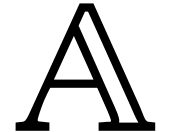 be an effective commutative ring, so that we
have algorithms for the ring operations. Given a monic polynomial
be an effective commutative ring, so that we
have algorithms for the ring operations. Given a monic polynomial 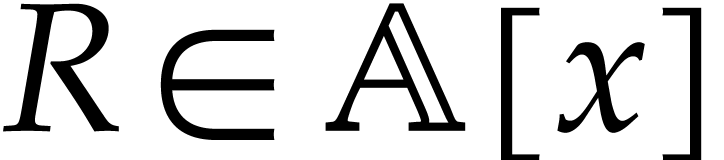 of degree
 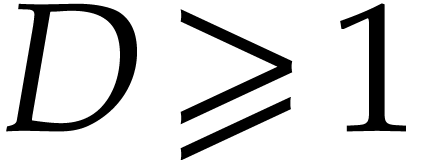 and polynomials
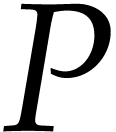 and
and 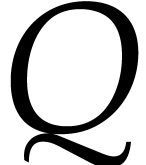 in
in 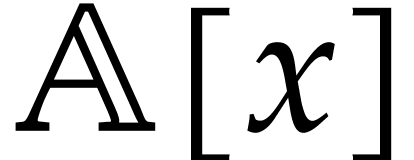 of degree
 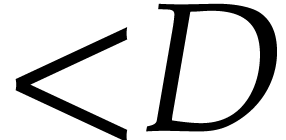 the computation of the remainder of
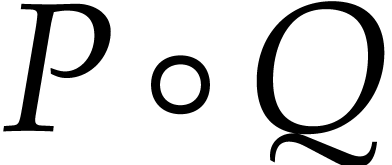 in the division by
 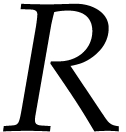 ,
written
,
written  , is called the
problem of modular composition. Modular composition is a
central operation in computer algebra, especially for irreducible
polynomial factorization; see [12] for instance. It is
still unknown whether modular composition can be achieved in time nearly
linear in
, is called the
problem of modular composition. Modular composition is a
central operation in computer algebra, especially for irreducible
polynomial factorization; see [12] for instance. It is
still unknown whether modular composition can be achieved in time nearly
linear in 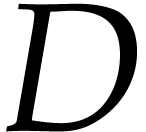 or not for any ground ring .
In this paper, we prove the following new complexity bound for when is a finite ring 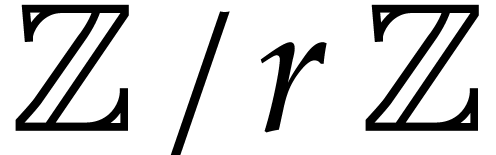 and where
 is a common abbreviation for
  .
.
This result improves upon the best previously known bound

given in [11, Theorem 4], which is derived from an algorithm due to Kedlaya and Umans [14]. The novelty of our approach is a reduction of modular composition to the floating point evaluation of a multivariate polynomial at a special set of points, a so-called spiroid. We take advantage of fast Fourier transforms to perform these evaluations. In contrast, previously known methods, in the vein of [14], rely on number theoretic constructions.
Let 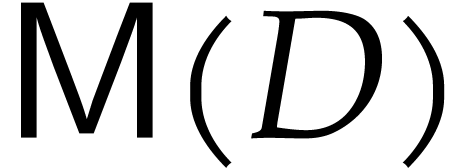 denote a cost function that bounds the
number of operations in
denote a cost function that bounds the
number of operations in 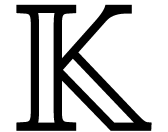 required to multiply two
polynomials of degree
required to multiply two
polynomials of degree 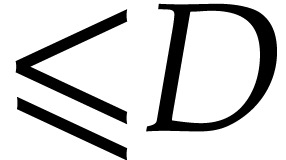 in
in  . Over any ring ,
modular composition can be performed with
. Over any ring ,
modular composition can be performed with 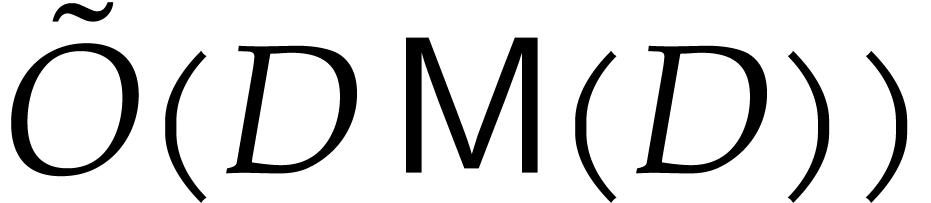 operations in by applying Horner's rule to
evaluate
operations in by applying Horner's rule to
evaluate 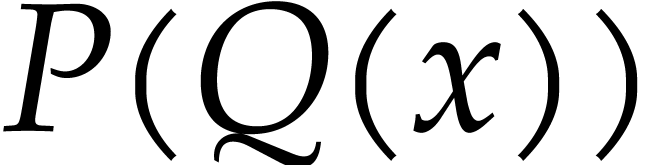 in
in  .
In 1978, Brent and Kung [3] gave a faster algorithm with
cost
.
In 1978, Brent and Kung [3] gave a faster algorithm with
cost  , that uses the
baby-step giant-step technique [17]. Their
algorithm even yielded a sub-quadratic cost
, that uses the
baby-step giant-step technique [17]. Their
algorithm even yielded a sub-quadratic cost  when
combined with fast linear algebra; see [13, p. 185]. Here,
the constant
when
combined with fast linear algebra; see [13, p. 185]. Here,
the constant 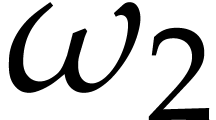 is a real value between 3 and 4
such that the product of a
is a real value between 3 and 4
such that the product of a 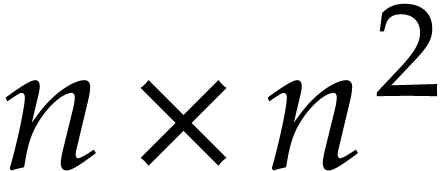 matrix by a
 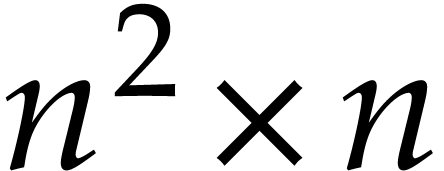 matrix takes
 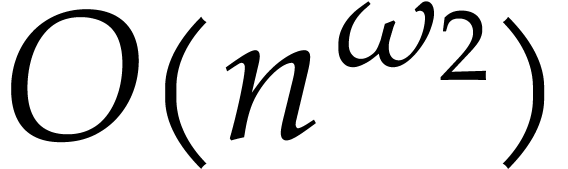 operations; one may
take
operations; one may
take  according to [19]. At present
time, the fastest known modular composition method over any ground field
is due to Neiger, Salvy, Schost, and Villard [16]: it is probabilistic of Las Vegas type and takes an
expected number of
according to [19]. At present
time, the fastest known modular composition method over any ground field
is due to Neiger, Salvy, Schost, and Villard [16]: it is probabilistic of Las Vegas type and takes an
expected number of

operations in ; see [16,
Theorem 1.1]. Here, the constant 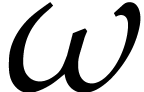 denotes any
real value between
denotes any
real value between 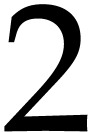 and
and 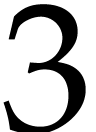 such that two
 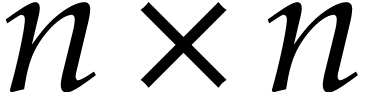 matrices over a commutative ring
can be multiplied with
matrices over a commutative ring
can be multiplied with 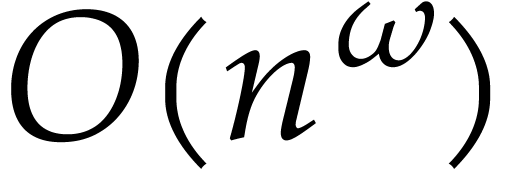 ring operations. The
current best known value is
ring operations. The
current best known value is  [19],
so we may take
[19],
so we may take 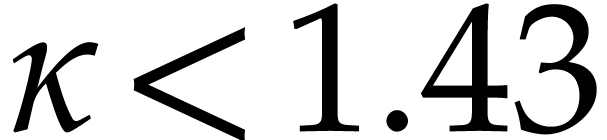 .
.
A major breakthrough for the modular composition problem is due to
Kedlaya and Umans [14] in the case where
is a finite field 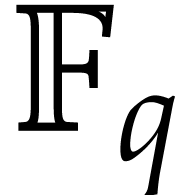 (and even more generally a
finite ring of the form
(and even more generally a
finite ring of the form  for any integer
  and
and 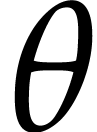 monic). For any fixed
real value
monic). For any fixed
real value 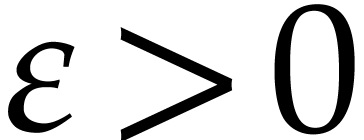 , they showed that
can be computed using
, they showed that
can be computed using  bit operations. The dependency in
  is analyzed in
[11]. Recent improvements of the Kedlaya–Umans
approach can be found in [1, 2], but the
dependency in is not detailed.
is analyzed in
[11]. Recent improvements of the Kedlaya–Umans
approach can be found in [1, 2], but the
dependency in is not detailed.
In [9, 10] it was shown how the knowledge of
factorizations of can be exploited to speed up
modular composition. An important special case concerns the composition
of power series, which corresponds to taking 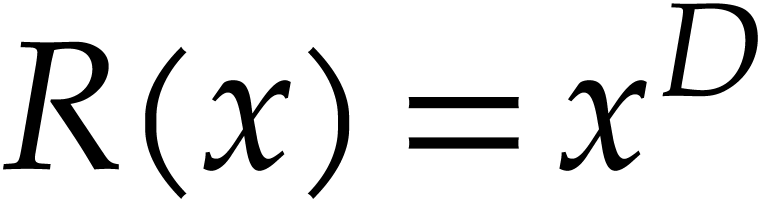 . Recently, Kinoshita and Li [15]
showed how to accomplish this task using
. Recently, Kinoshita and Li [15]
showed how to accomplish this task using  operations in .
Our modular composition algorithm will be presented in section 5: Theorem 1 follows from the sharper complexity bound given in Theorem 24. As in [14], the problem will be reduced to the multi-point evaluation of a multivariate polynomial, using Kronecker segmentation. But, instead of relying on finite field arithmetic, we benefit from floating point arithmetic and reduce the multi-point evaluation to a deformation of the fast Fourier transform. The deformed evaluation point set is presented in section 3. Corresponding evaluation and interpolation algorithms are given in section 4. The next section gathers prerequisites.
For complexity analyses, we will consider bit complexity models such as
computation trees or RAM machines [4, 5]. The
function 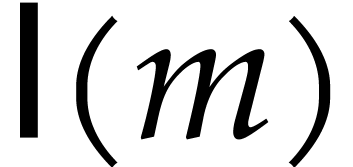 will bound the bit cost for multiplying
two integers of bit size
will bound the bit cost for multiplying
two integers of bit size 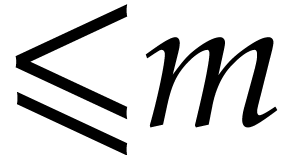 . We
will assume that
. We
will assume that 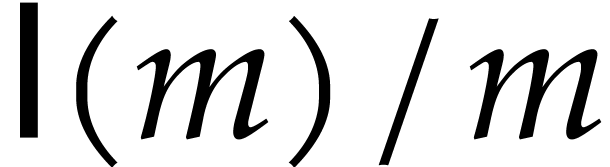 is nondecreasing. At the end,
we will make use of the fast product of [6], that yields
is nondecreasing. At the end,
we will make use of the fast product of [6], that yields
 .
.
Numbers will be represented in radix ,
with a finite number of digits. We will represent fixed point numbers by
a signed mantissa and a fixed exponent. More precisely, given a
precision parameter 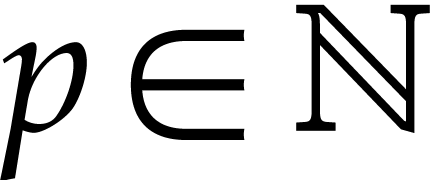 , we
denote by
, we
denote by 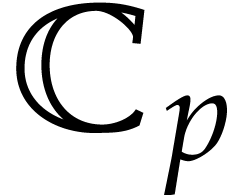 the set of complex numbers of the form
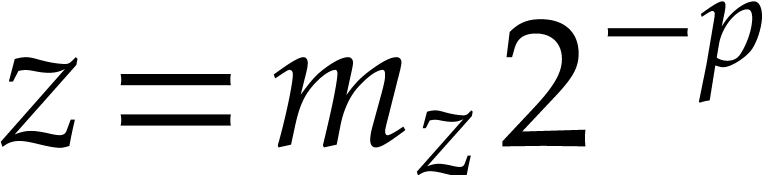 , where
 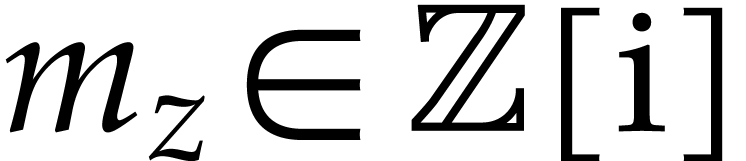 and
and 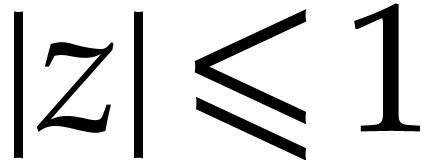 . We write
 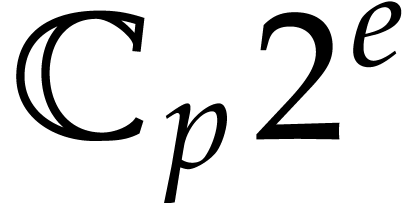 for the set of complex numbers of the form
 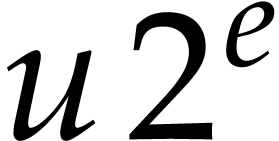 , where
 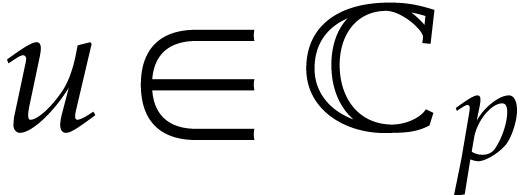 and
and 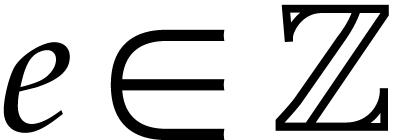 ; in particular, for
 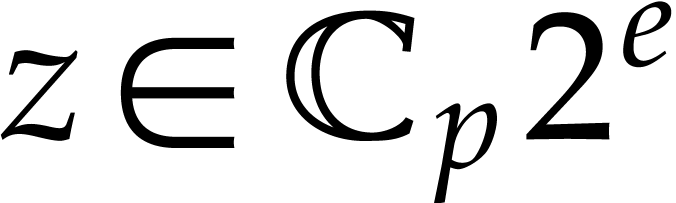 we always have
 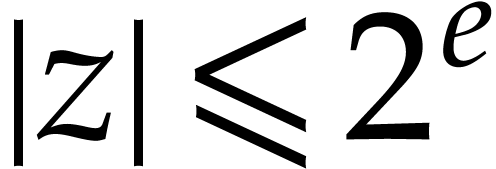 .
At every stage of our algorithms, the exponent
.
At every stage of our algorithms, the exponent  will be specified, so the exponents do not have to be stored or
manipulated explicitly.
will be specified, so the exponents do not have to be stored or
manipulated explicitly.
In the error analyses of our numerical algorithms, each
is really the approximation of some genuine complex number 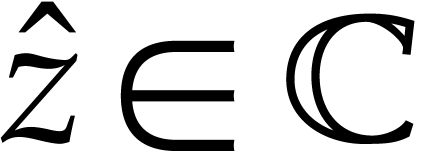 . So each such
  comes
with an implicit error bound
comes
with an implicit error bound 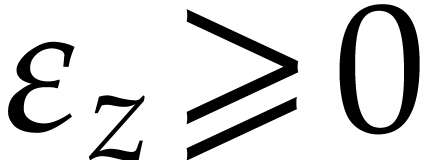 ;
this is a real number for which we can guarantee that
;
this is a real number for which we can guarantee that 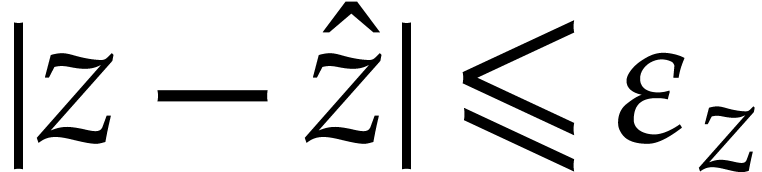 . A truncation of
 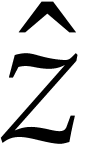 is an approximation of
that is rounded towards zero in the sense that
is an approximation of
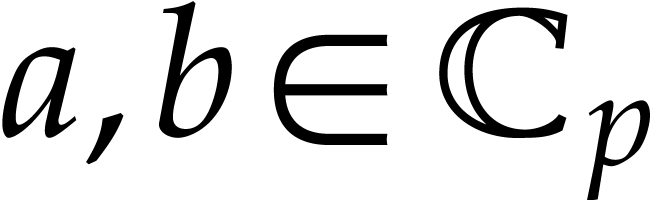
that is rounded towards zero in the sense that 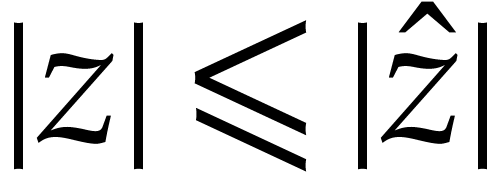 . Given
  ,
the sum
,
the sum 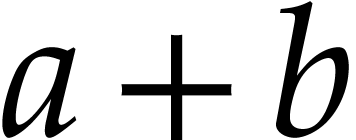 can be computed exactly in time
 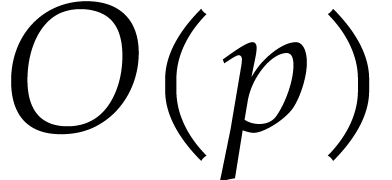 . The product
 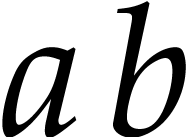 can be computed exactly in time
 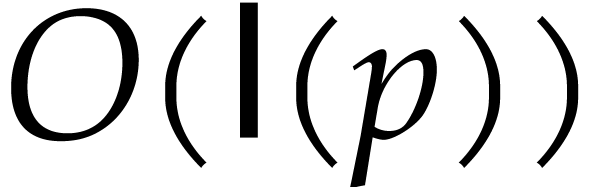 .
.
Proof. Rounding  into
into
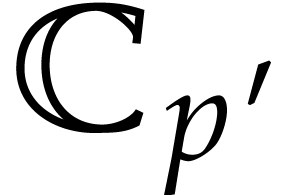 can be done as follows: let
 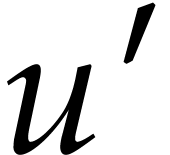 and
and 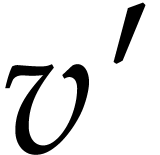 be the truncations to the nearest of
 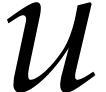 and
and  into
and let
into
and let  ; Then we have
  .
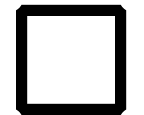
.
Proof. Rounding towards
zero into can be done as follows: let and be the truncations of and at precision 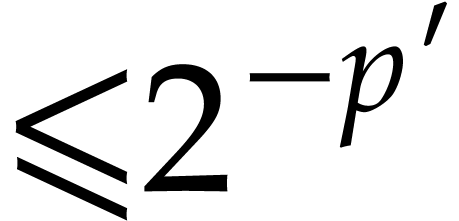 and let ; Then
we have
and let ; Then
we have 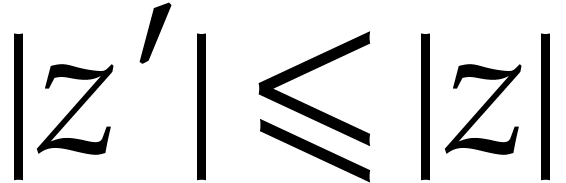 and
and 
Let 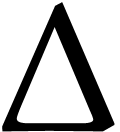 be a power of and
let
be a power of and
let  be a vector of complex numbers. We write
 and
and 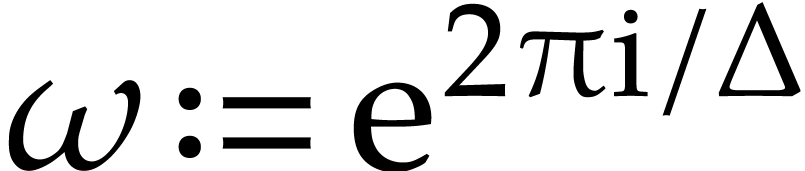 .
.
Proof. We use [7, Proposition 4] at
precision  in order to obtain first
approximations of
in order to obtain first
approximations of  in
in 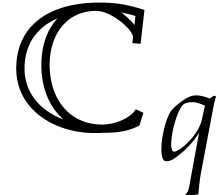 with error
 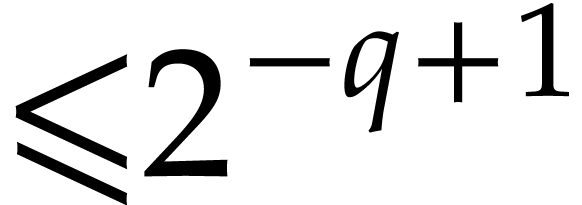 . We next truncate
these results in , which
yields an overall error
. We next truncate
these results in , which
yields an overall error  thanks to Lemma 3.
We define the fast Fourier transform of 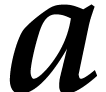 to be
to be

where  . In particular, we
have
. In particular, we
have  .
.
Proof. Thanks to [18, section 3] an
approximation of 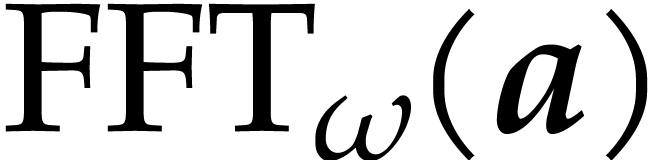 in
in 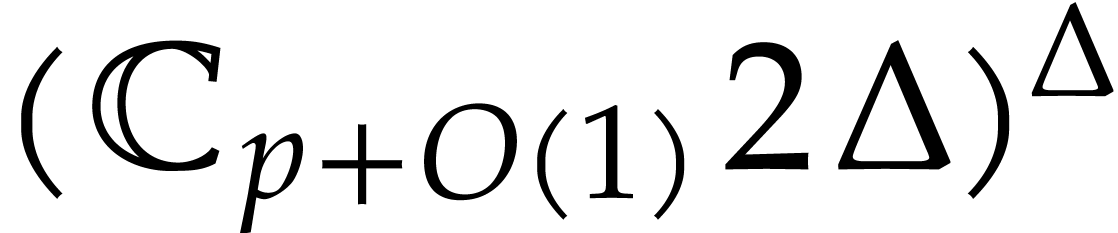 can
be computed with error
can
be computed with error 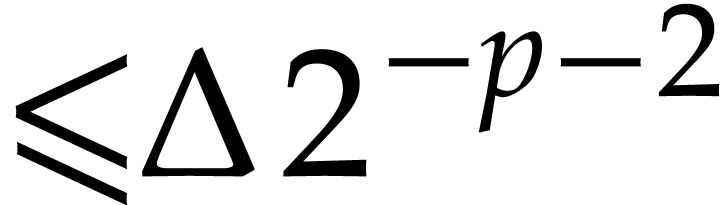 in time
  . Consider an entry
 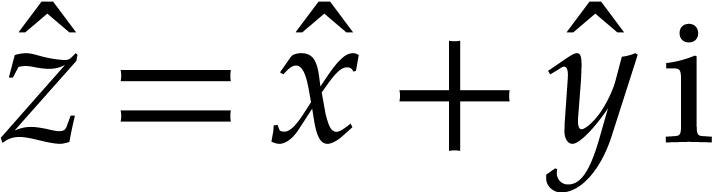 of
and let
of
and let 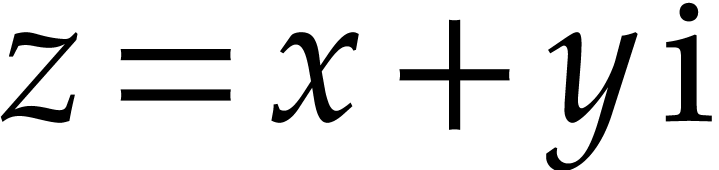 be the
corresponding approximation. Let
be the
corresponding approximation. Let 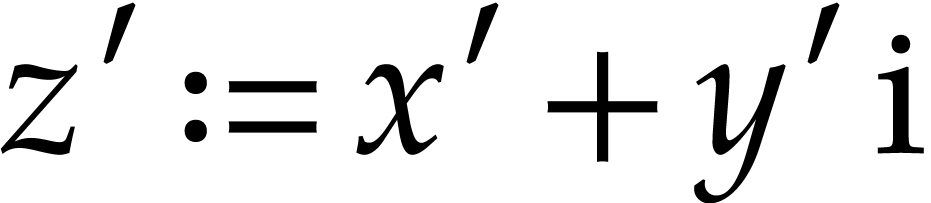 ,
where
,
where  and
and  .
Then
.
Then 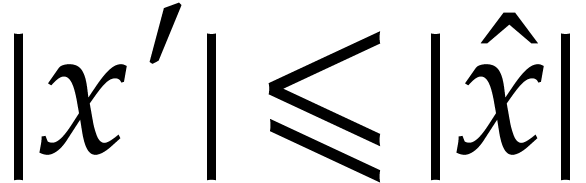 ,
, 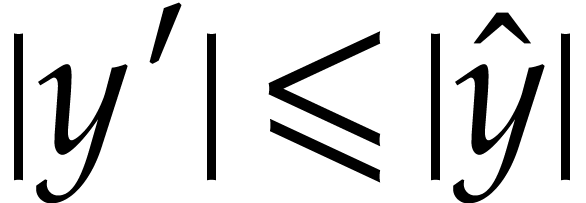 , and
, and  .
We may clearly compute
.
We may clearly compute 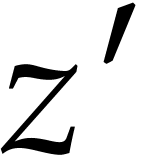 in time
  . Thanks to Lemma 3, and using
further operations, we may next compute a
truncation
. Thanks to Lemma 3, and using
further operations, we may next compute a
truncation 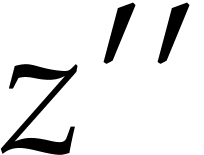 of
of 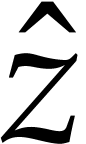 with error
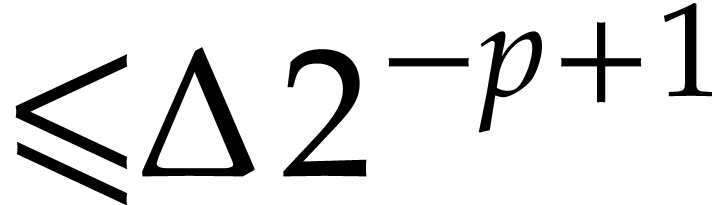 .
.
Proof. If 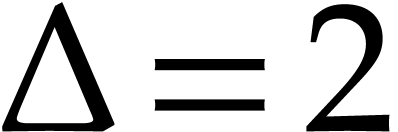 ,
then
,
then  . Otherwise,
 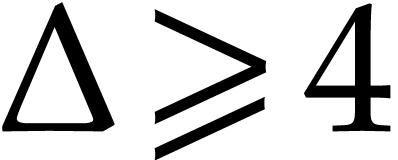 and we have

Given integers  , we define

where 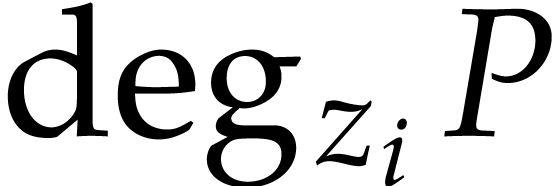 denotes the partial degree of in
 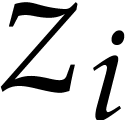 , for
, for  . In this paper, a dense
representation will be used for univariate and multivariate polynomials.
This means that a polynomial
. In this paper, a dense
representation will be used for univariate and multivariate polynomials.
This means that a polynomial  is stored as a
vector of size
is stored as a
vector of size  made of the coefficients of the
terms of of partial degree
made of the coefficients of the
terms of of partial degree 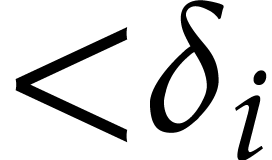 in , for . Precisely, when
 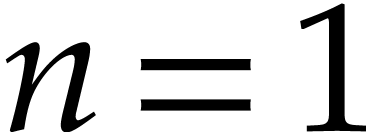 ,
a polynomial
,
a polynomial 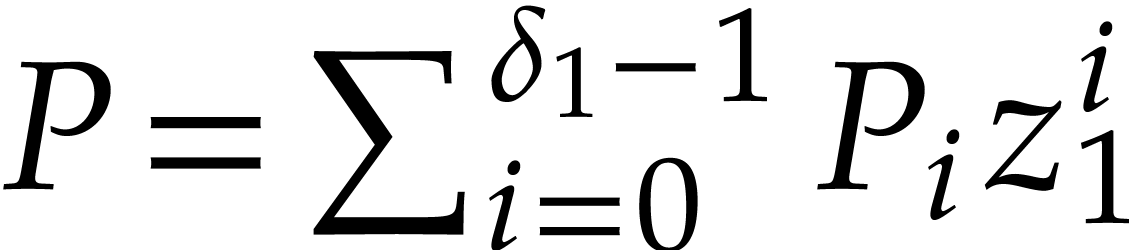 is stored as the vector
  . When
 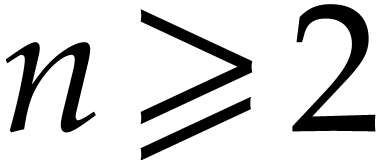 , a polynomial will be
regarded as a univariate polynomial in
, a polynomial will be
regarded as a univariate polynomial in 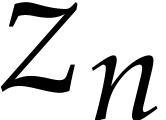 whose
coefficients are polynomials in
whose
coefficients are polynomials in  .
.
Given a polynomial  , we
define
, we
define

Given polynomials  the sum
 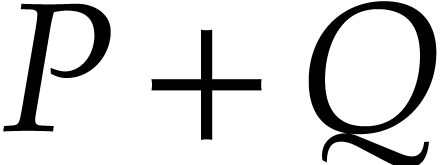 can be computed exactly in time
 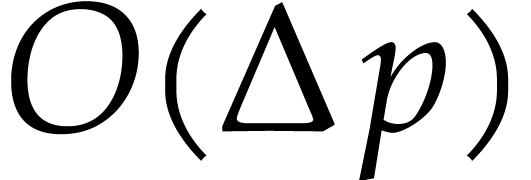 .
The product
.
The product 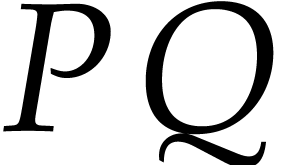 can be computed exactly in time
  using Kronecker substitution; see [5,
Chapter 8]. In addition we have
using Kronecker substitution; see [5,
Chapter 8]. In addition we have 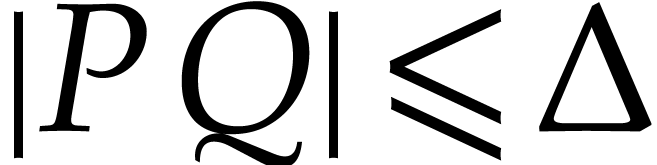 .
.
Given integers , we let and consider a tuple of points

We define  and call

the vanishing ideal of 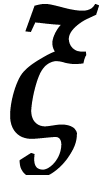 .
We also define the evaluation map
.
We also define the evaluation map

We refer to the computation of 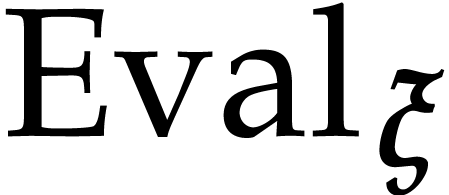 as the problem of
multi-point evaluation. The computation of
as the problem of
multi-point evaluation. The computation of 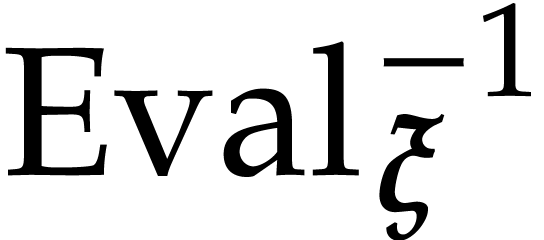 is called the interpolation problem. is
a bijection for a Zariski dense subset of tuples
is called the interpolation problem. is
a bijection for a Zariski dense subset of tuples 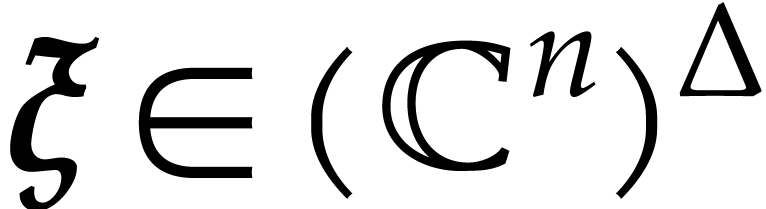 . Whenever this is the case, the points
  are pairwise distinct, so we have a natural bijection

This allows us to use polynomials in  as
canonical representatives of residue classes in
as
canonical representatives of residue classes in  . In particular, given a polynomial
  , we define
 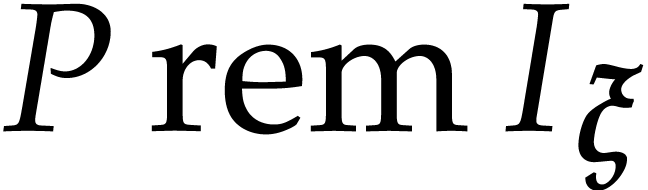 to be the
unique polynomial in with
to be the
unique polynomial in with  . For special tuples ,
called spiroids, we will show in this section that can be computed efficiently.
. For special tuples ,
called spiroids, we will show in this section that can be computed efficiently.
Assume from now that  are powers of two and let
be the standard primitive -th root of unity in
are powers of two and let
be the standard primitive -th root of unity in 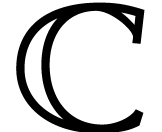 .
For each
.
For each  , we let

We call the tuple  a regular spiroid.
The vanishing ideal
a regular spiroid.
The vanishing ideal 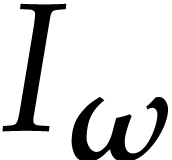 of this tuple of points is
generated by the polynomials
of this tuple of points is
generated by the polynomials
 |
(1) |
A straightforward computation shows that these generators actually form
a Gröbner basis for the grevlex monomial ordering. For instance,
for 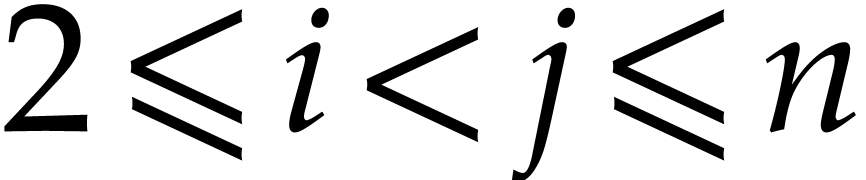 , the
, the  -polynomial of
 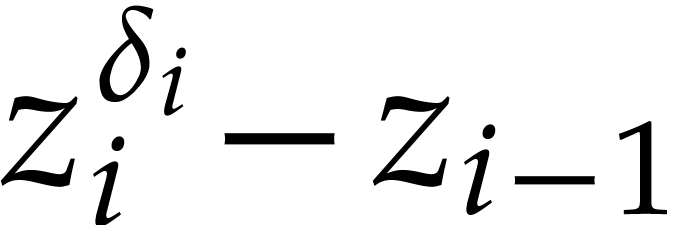 and
and 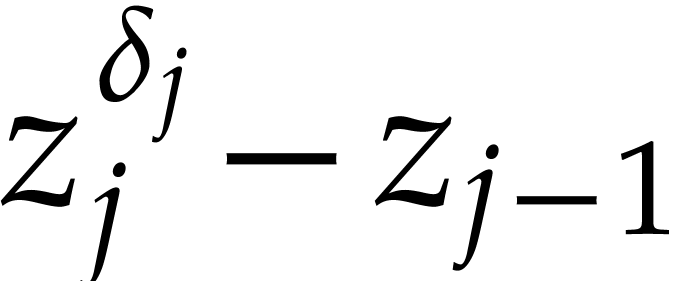 is
is

which reduces to  . In
particular, the monomials in are reduced.
. In
particular, the monomials in are reduced.
Let  ,
,  , and
, and  .
For
.
For  , we have

For convenience, we also set

Given  and a family

we say that 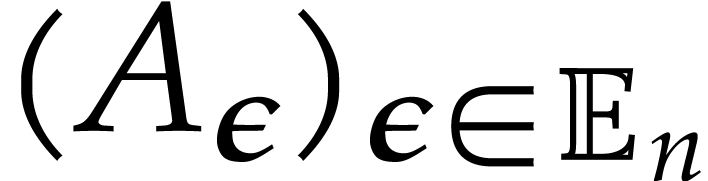 is an extended reduction of
modulo if
is an extended reduction of
modulo if

Since 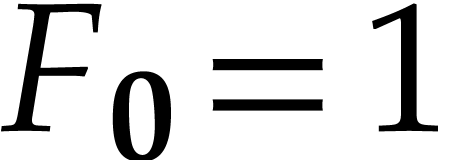 , we have
  . We further define
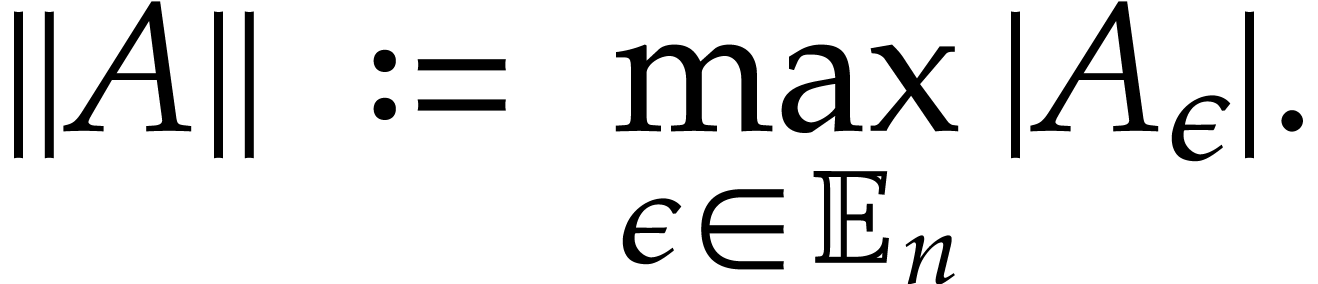
Given  we aim at computing an extended reduction
of by .
As a first step we begin with polynomials in
we aim at computing an extended reduction
of by .
As a first step we begin with polynomials in
 .
.
Proof. Since is
generated by binomial polynomials is a monomial.
The defining equations further imply that  are
invertible in
are
invertible in  .
.
The support 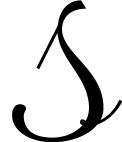 of a polynomial is the set of its monomials with a non-zero coefficient.
We say that the monomials of are pairwise
distinct modulo when any two distinct monomials
of have distinct projections in .
of a polynomial is the set of its monomials with a non-zero coefficient.
We say that the monomials of are pairwise
distinct modulo when any two distinct monomials
of have distinct projections in .
 be such that the monomials of its support are
pairwise distinct modulo .
Let
be such that the monomials of its support are
pairwise distinct modulo .
Let 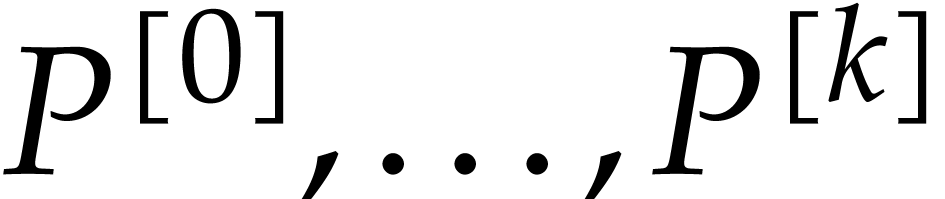 be defined recursively as follows:
 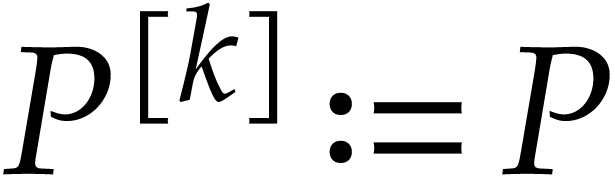 , and
, and
 |
(2) |
where

for  . For
. For  , the following properties hold:
 ,
,
the monomials of the support of 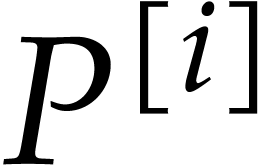 are
pairwise distinct modulo ,
are
pairwise distinct modulo ,
the coefficients of are coefficients of
.
Letting 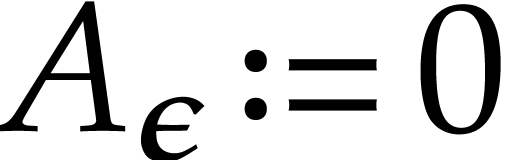 for
for  and
and
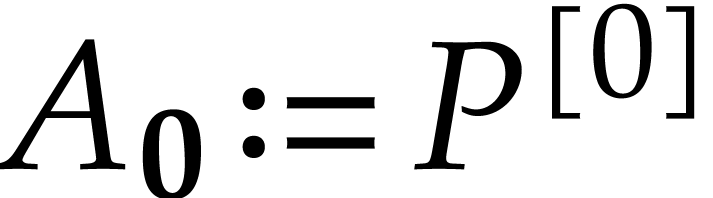 , the family
 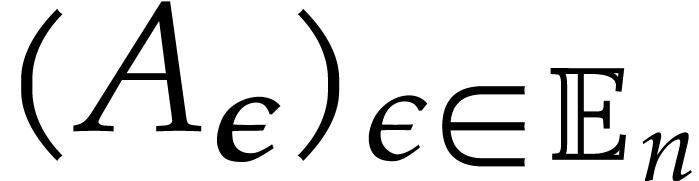 is an extended reduction of
 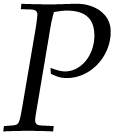 .
.
Proof. The proof is done by induction on 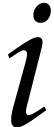 . The properties are clear for
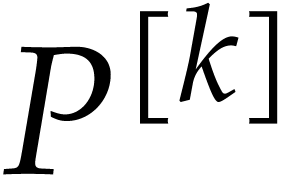 . Let us assume that they
hold for
. Let us assume that they
hold for 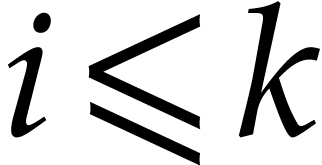 . We decompose into
 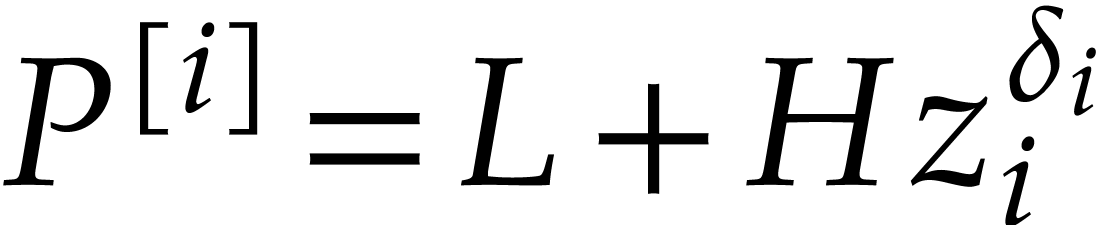 with
with

We verify that

where

Since the monomials of the support of are
pairwise distinct modulo ,
the supports of 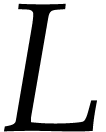 and
and 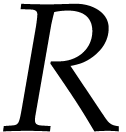 are
disjoint. In particular the monomials of the support of
are
disjoint. In particular the monomials of the support of  are pairwise distinct modulo ,
and the non-zero coefficients of
are pairwise distinct modulo ,
and the non-zero coefficients of 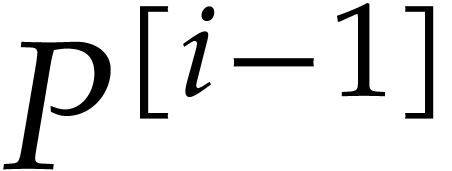 are
coefficients of .
are
coefficients of .
Finally unrolling

which constitutes the extended reduction of .
The reduction of a general modulo can be performed efficiently by the following algorithm.
Algorithm
For all  set
set

and compute

Let 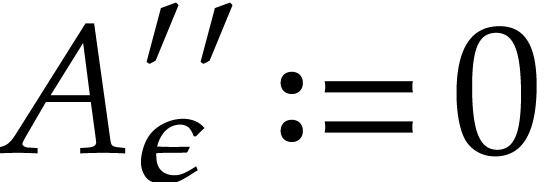 for
for  ,
and for
,
and for 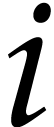 from
from  down to
 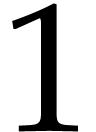 do:
do:
For all , set

Compute  .
.
Let 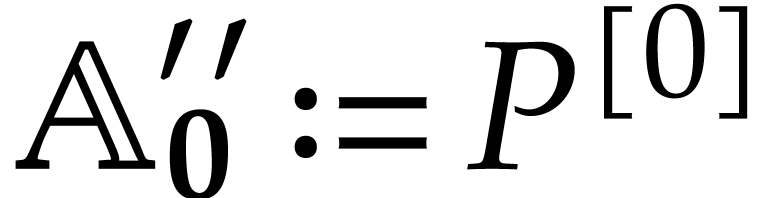 , compute
  for
for 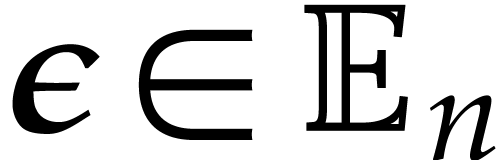 ,
and return .
,
and return .
 .
.
Proof. For all ,
we have  . Let us examine the
particular case where
. Let us examine the
particular case where 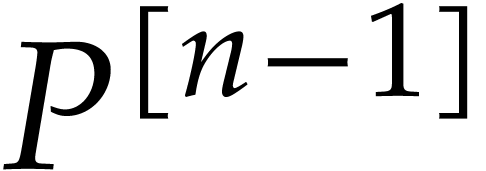 restricts to a single term
 for some
 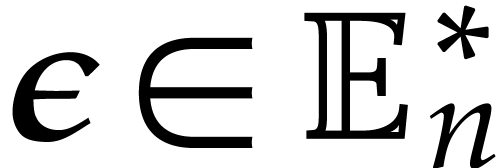 .
By Lemma 7, the monomials of the support of are pairwise distinct modulo ,
so Lemma 8 implies the following properties, for
.
By Lemma 7, the monomials of the support of are pairwise distinct modulo ,
so Lemma 8 implies the following properties, for  :
:
,
the coefficients of are coefficients of
, hence of ,
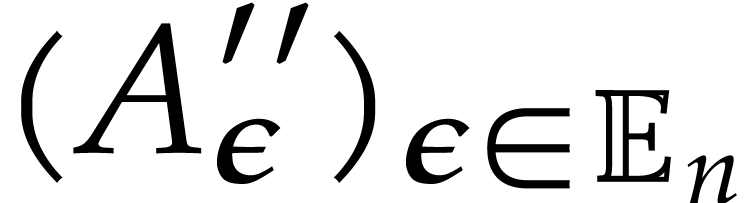 is an extended reduction of .
Since the operations in step 2 are linear with respect to the
coefficients of , the general
case where is a sum of 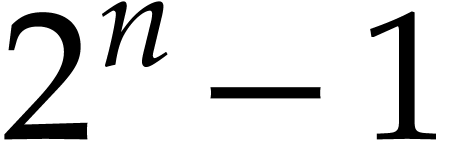 terms of the form satisfies the following
properties:
terms of the form satisfies the following
properties:
 ,
,
 ,
,
is an extended reduction of .
On the other hand step 1 yields

So the correctness proof is completed by noting that

and  . As for the complexity
analysis, step 1 takes time .
Step 2 runs in time
. As for the complexity
analysis, step 1 takes time .
Step 2 runs in time

The cost of step 3 does not exceed .
Example. Let 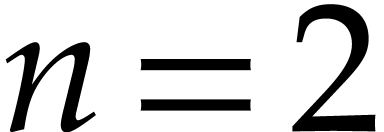 and
and  . With the notation as in Algorithm
1, the only non-zero
. With the notation as in Algorithm
1, the only non-zero  is
is  , and we have
 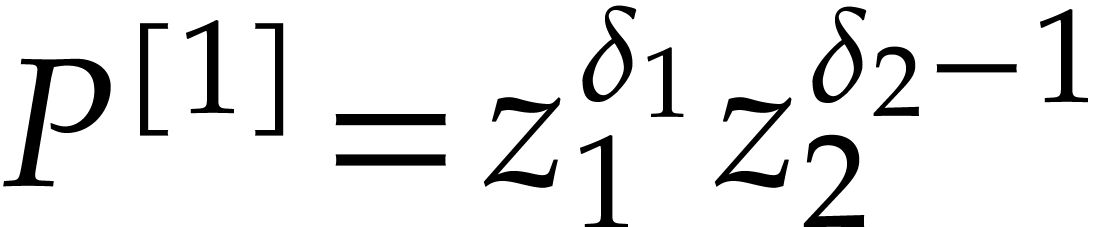 . It follows that all the
 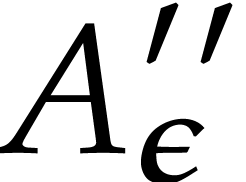 are all
 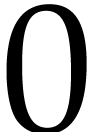 but
but 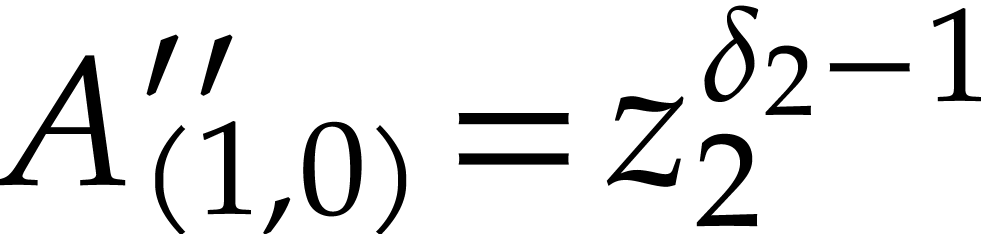 ,
so we have
,
so we have 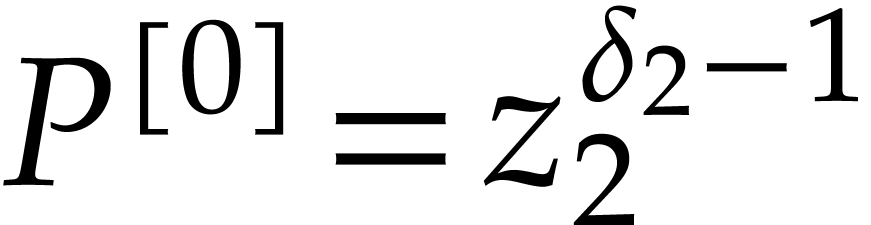 . The extended
reduction of is
. The extended
reduction of is

We now turn to the situation where is a
sufficiently small perturbation of 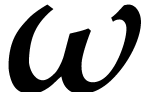 .
More precisely, we say that is a
spiroid when there exist polynomials
.
More precisely, we say that is a
spiroid when there exist polynomials

such that

for all , and

with the convention that 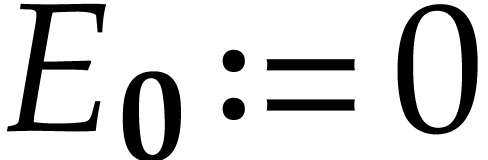 and
and 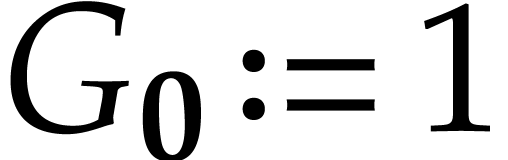 . We call
 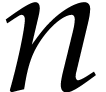 and
and 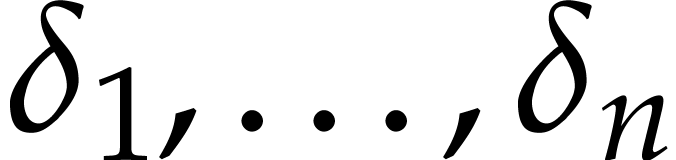 the dimension and the degrees of the
spiroid and let
the dimension and the degrees of the
spiroid and let

By Lemma 6 we have  for all
 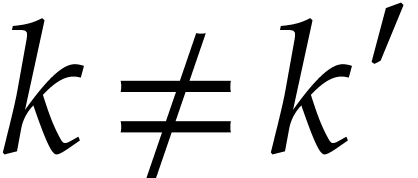 . Consequently,

so the points 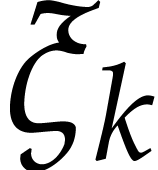 are pairwise distinct. We let
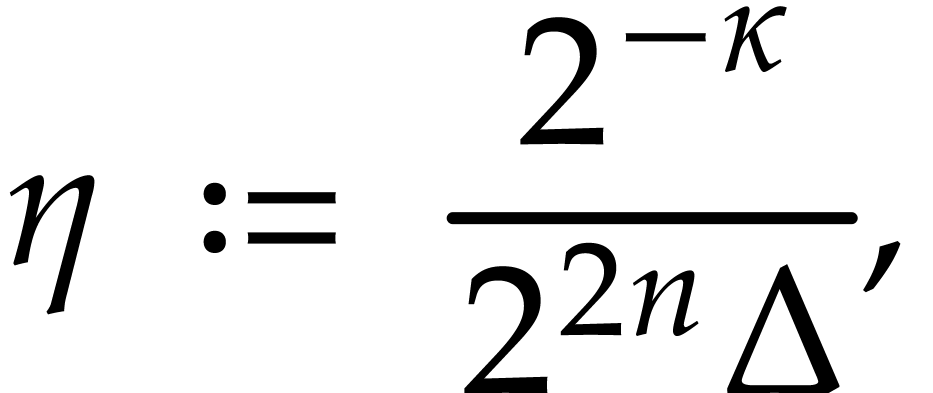
where 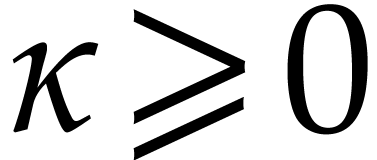 is a constant, that will be specified
later. We denote by
is a constant, that will be specified
later. We denote by  an approximation of
 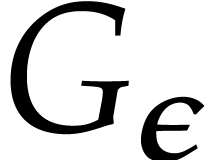 with error
 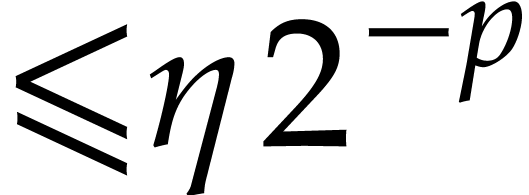 ,
where
,
where  will also be defined later. For
convenience we always take
will also be defined later. For
convenience we always take 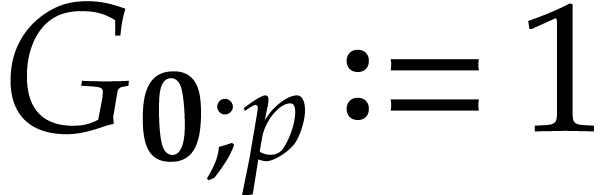 .
.
We are to show that is a spiroid as soon as 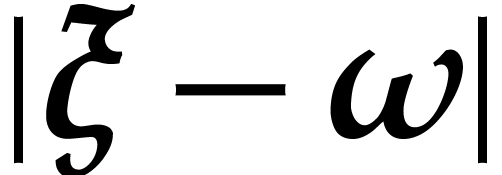 is sufficiently small.
Proof. The polynomial  has degree

and satisfies 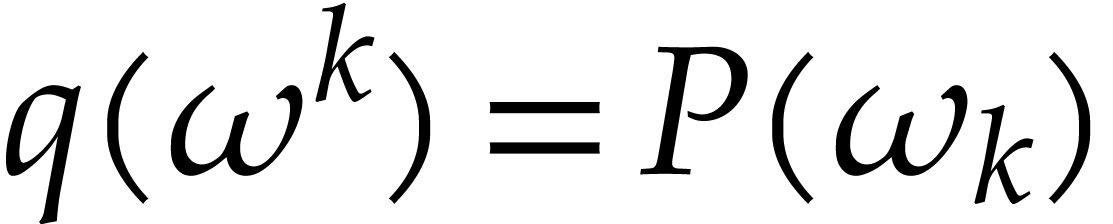 for
for  .
This means that
.
This means that 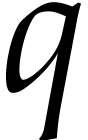 is the inverse Fourier transform
of
is the inverse Fourier transform
of 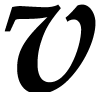 , that is
  , following the notation of section 2.2.
We deduce that
, following the notation of section 2.2.
We deduce that 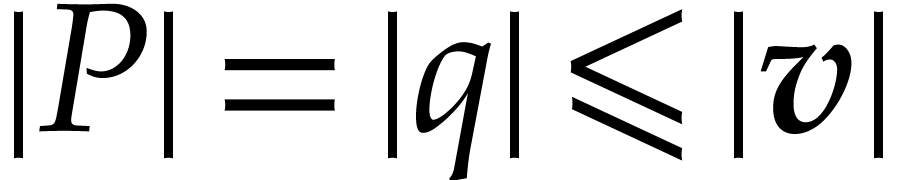 .
.
The two following technical lemmas will be needed several times in the paper.
Proof. We set  for
for  and use the classical inequality

From  , we obtain

Proof. We verify that

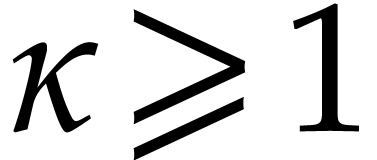 ,
,  , and let be such
that
, and let be such
that 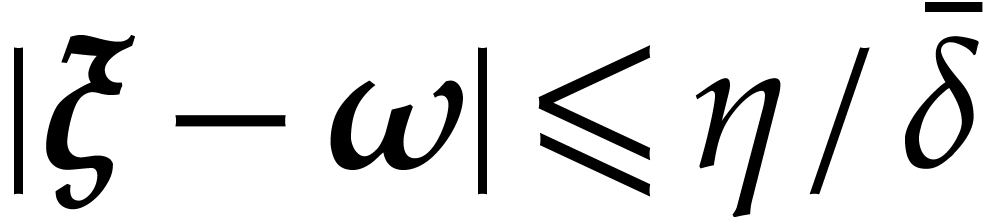 . Given
  , there exists a unique
  such that
 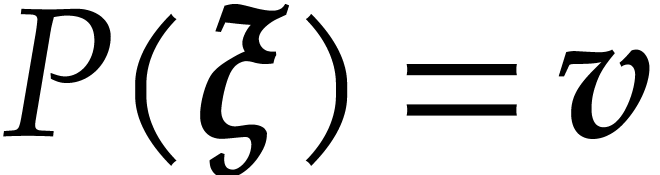 . Moreover,
 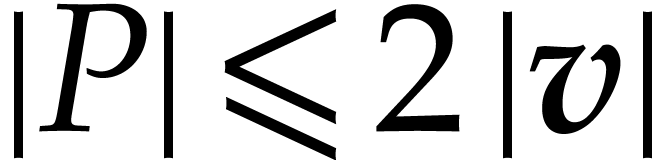 .
.
Proof. Let 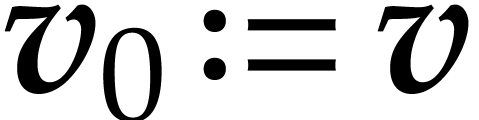 and define
 , where
 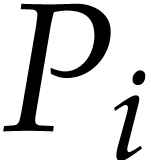 stands for the unique polynomial in such that
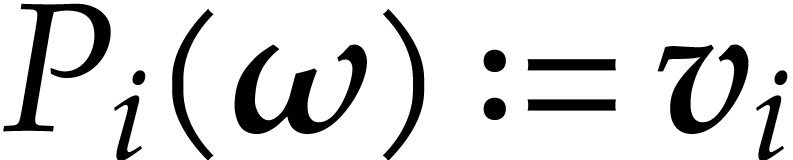 . From Lemma 10
we know that
. From Lemma 10
we know that 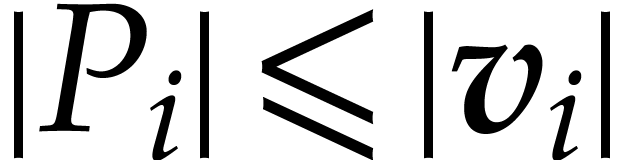 . Using Lemma 11, we deduce

Using Lemma 12 and ,
we obtain  , hence
 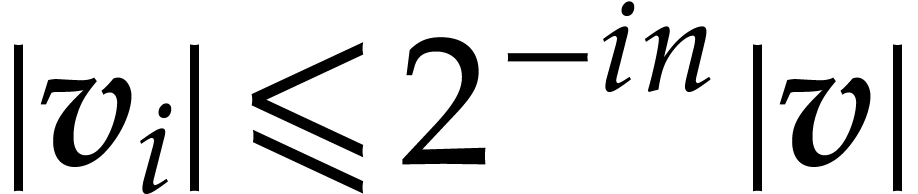 for
for 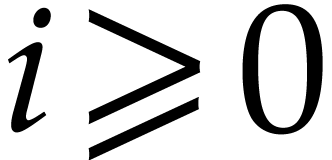 .
Consequently,
.
Consequently, 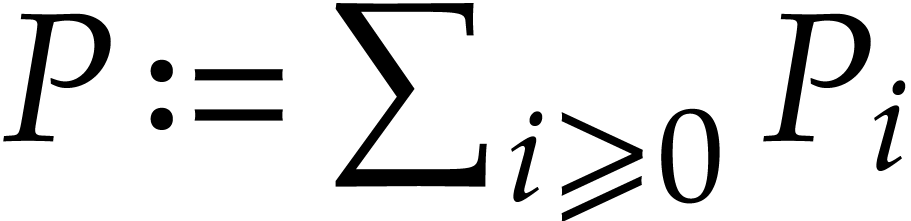 is well defined and we have

Finally, we verify that

Proof. From Lemmas 11 and 12, and using

we obtain
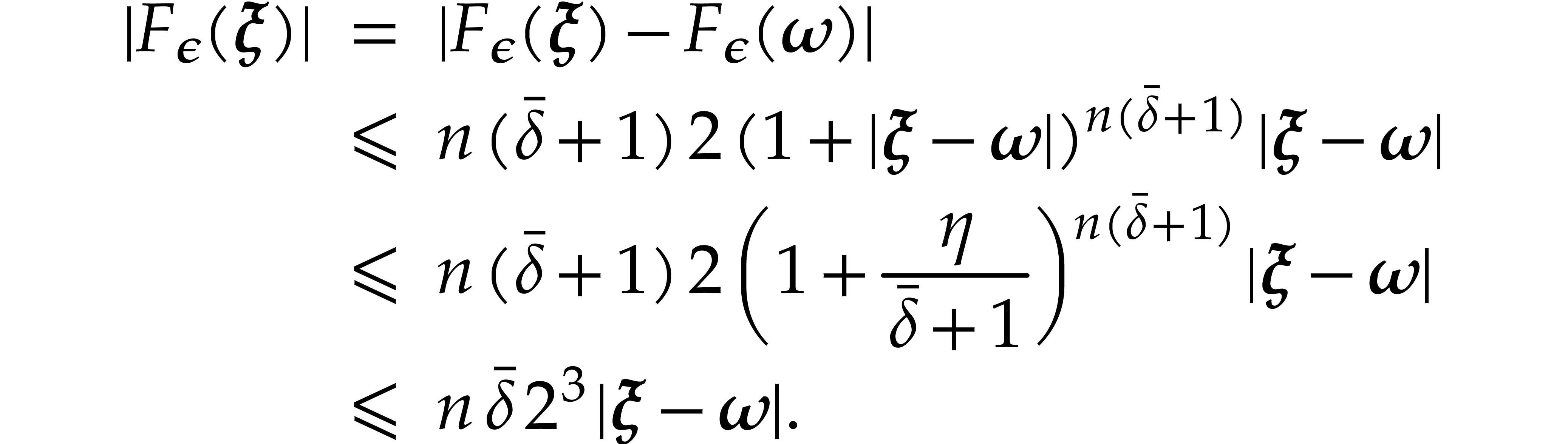
Thanks to Lemma 13, there exists  such that
  and
and

whence  .
.
In the rest of this section, we fix and assume
that is a spiroid. A family

is called an extended reduction of by
the spiroid if
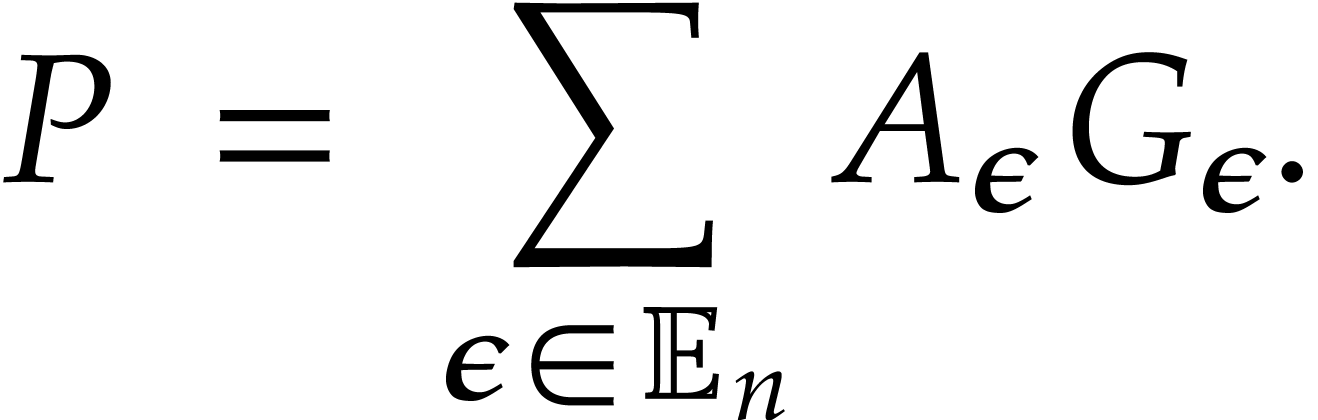
Since 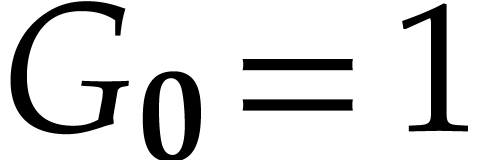 , we have
  .
.
Proof. If 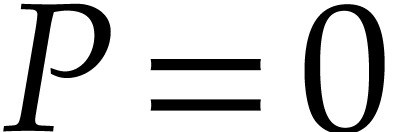 then we take
for all .
Otherwise, without loss of generality, we may assume that
then we take
for all .
Otherwise, without loss of generality, we may assume that 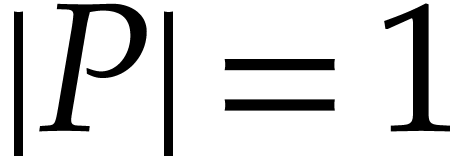 . For
. For 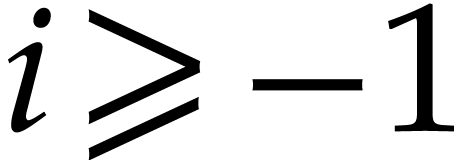 ,
we construct sequences ,
,
we construct sequences , 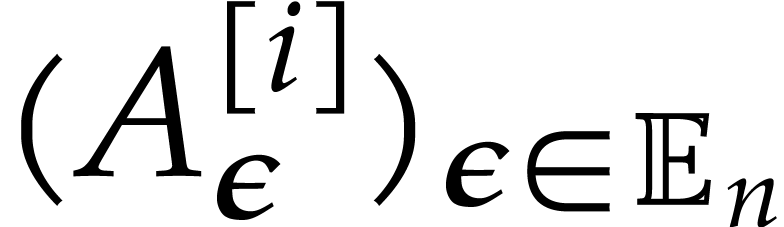 of polynomials as follows. For
 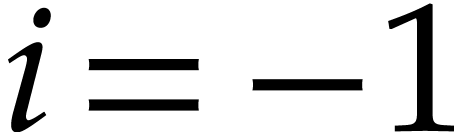 , we set
 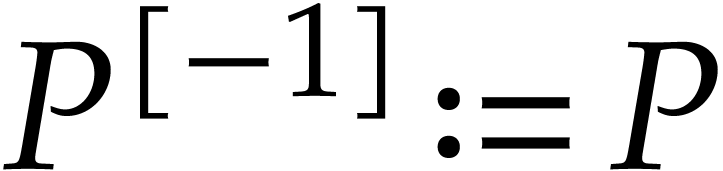 and
and 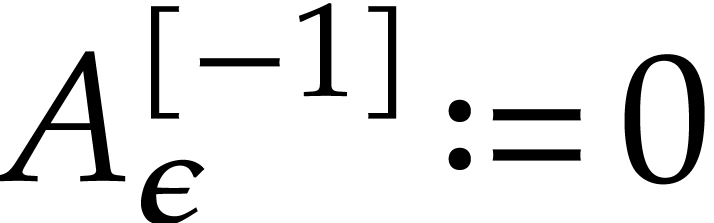 for . By
induction, we assume that these sequences are defined up to some index
for . By
induction, we assume that these sequences are defined up to some index
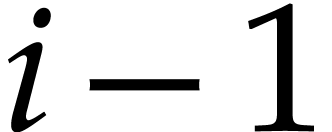 for some .
We let
for some .
We let

and apply Proposition 9 to without
any rounding, and let 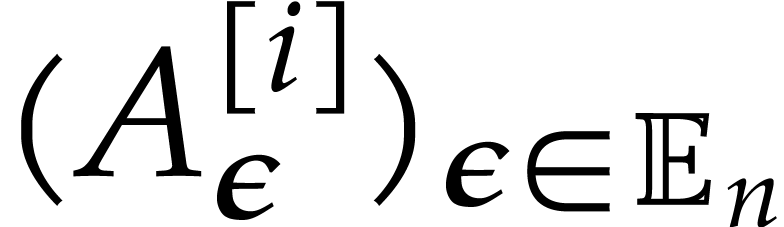 be the corresponding
extended reduction with
be the corresponding
extended reduction with  . We
have
. We
have
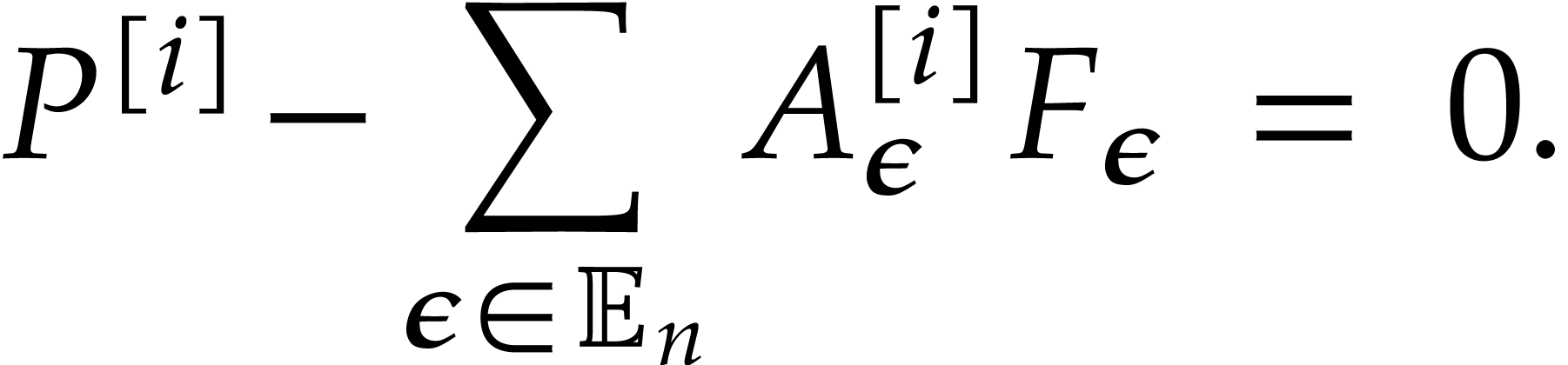
It follows that
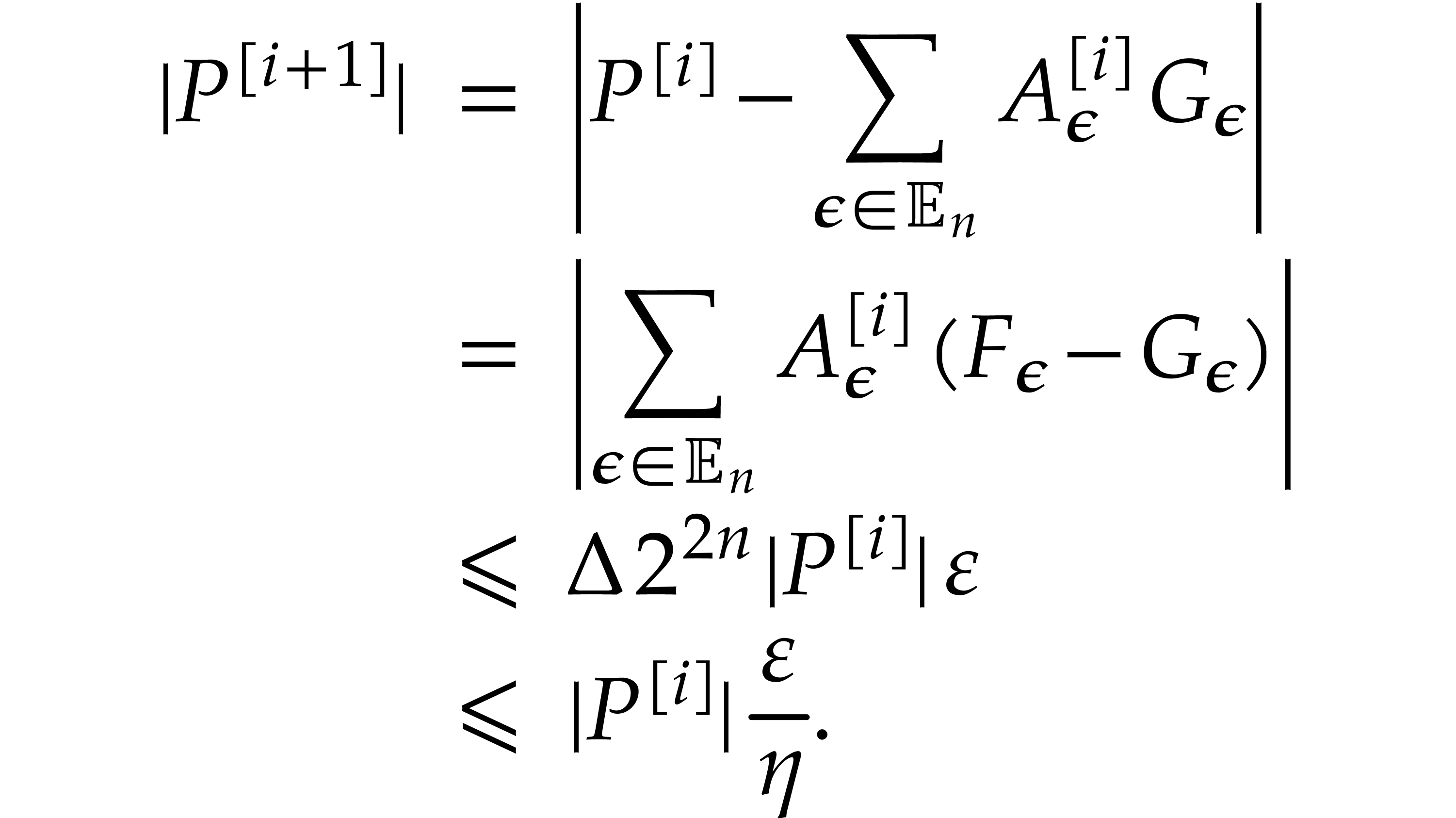
Hence,
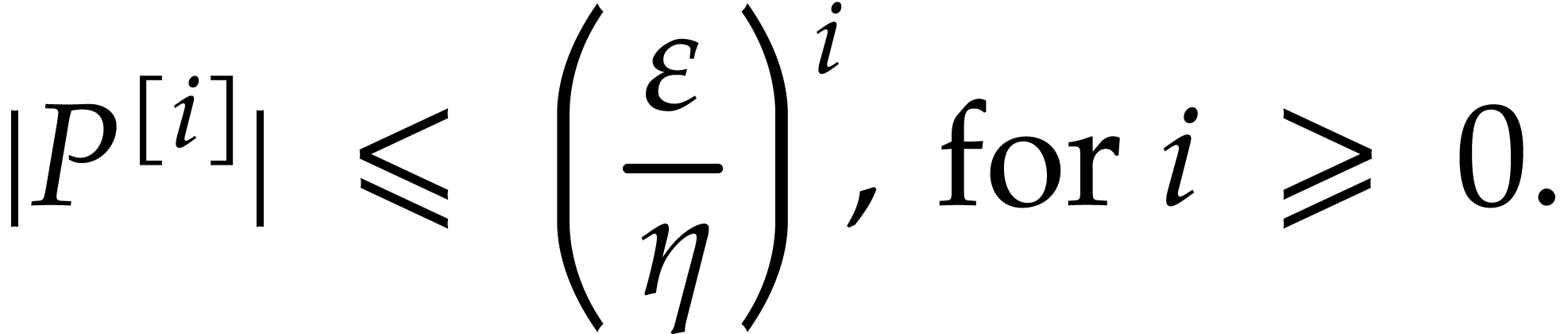
In particular 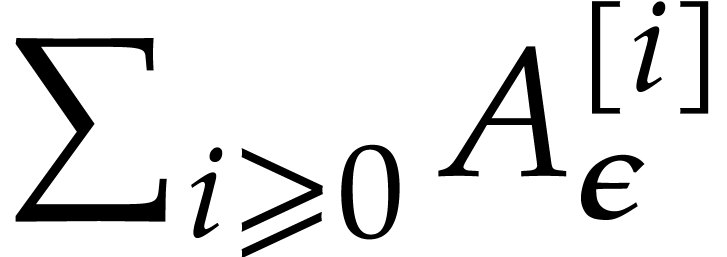 converges to a limit written
 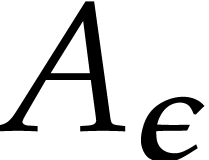 . For we
have
. For we
have

The proof of Proposition 15 can be turned into an algorithm
to compute approximations of extended reductions. For efficiency
reasons,  is required to be sufficiently small.
Proof. We adapt the proof of Proposition 15. For 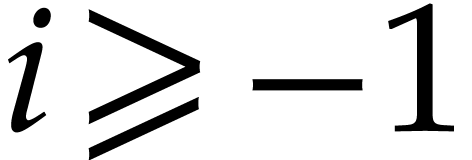 , we
construct sequences
, we
construct sequences  with
with 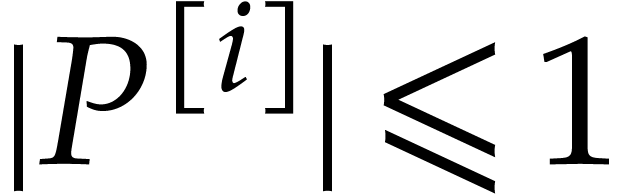 and
and  as follows.
For , we set
and for .
By induction, we assume that these sequences have been defined up to
for some .
We compute

exactly. Note that 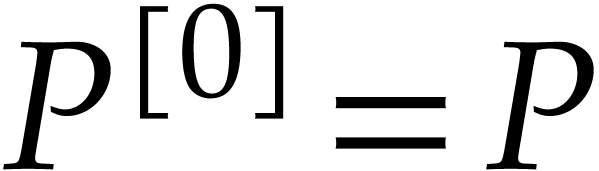 . We
further assume by induction that .
Applying Proposition 9 to ,
let
. We
further assume by induction that .
Applying Proposition 9 to ,
let 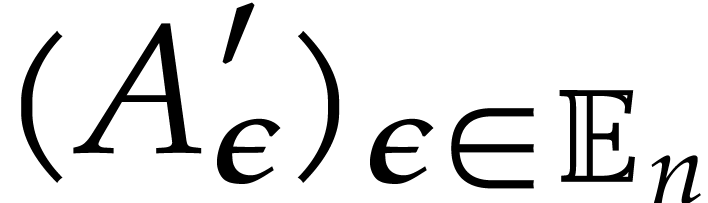 be the obtained extended reduction. Then
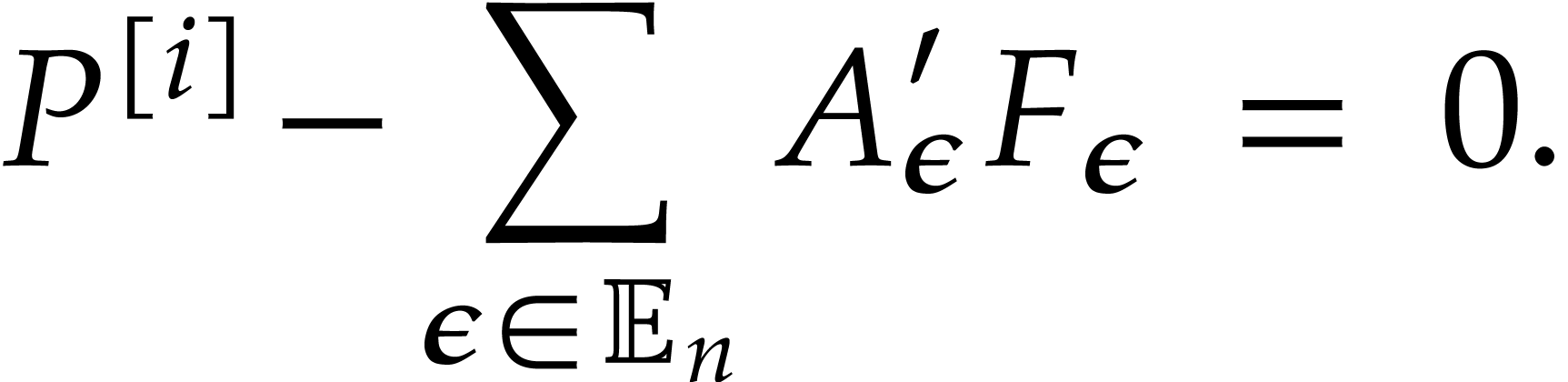
Using Lemma 3, we compute a truncation  of in
of in  with error
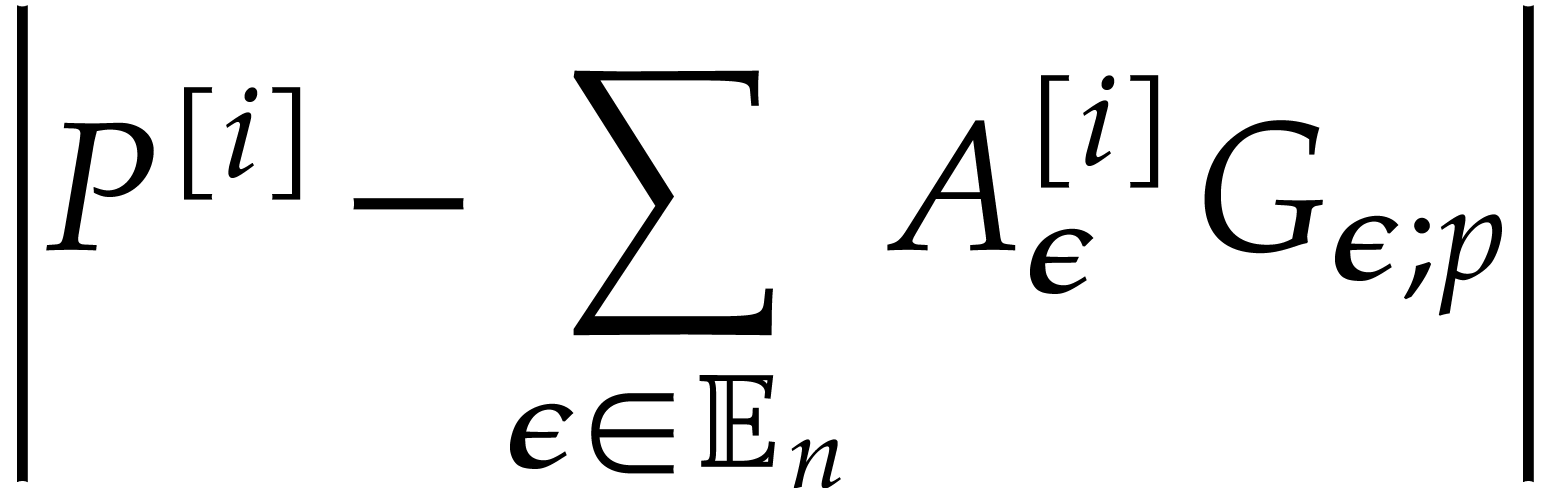
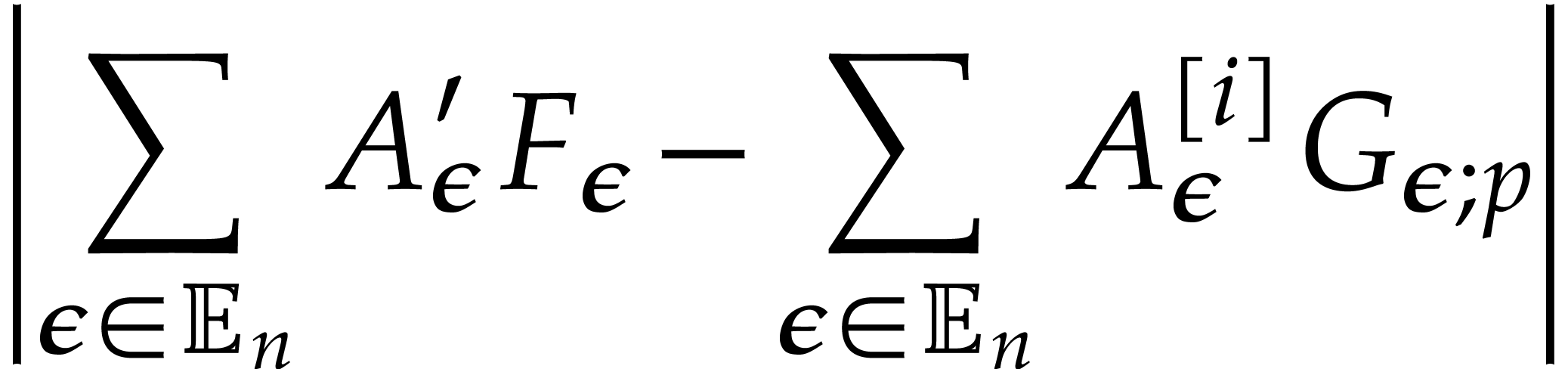
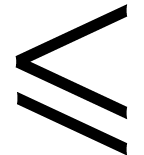
  . We obtain
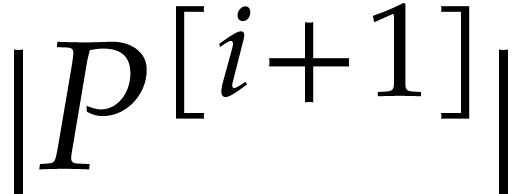 |
 |
 |
|
|
 |
||
 |
 |
||
|
 |
||
|
 |
||
|
 |
(since 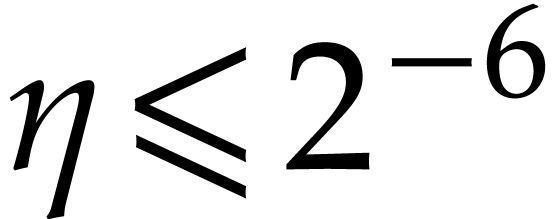 ) ) |
Iterating the latter inequality yields
In particular, 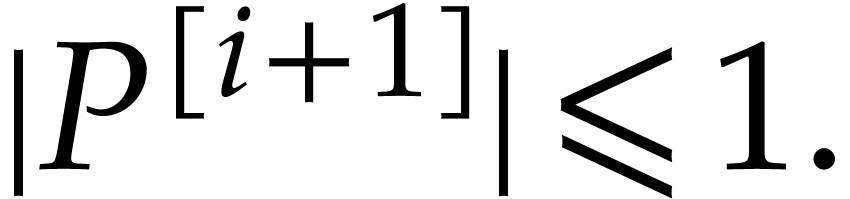 We are done with the construction
of the sequences and . Let
We are done with the construction
of the sequences and . Let 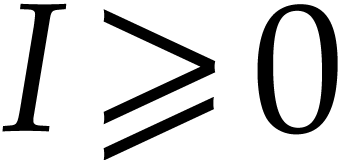 be the smallest
integer such that
be the smallest
integer such that
 |
(4) |
that is
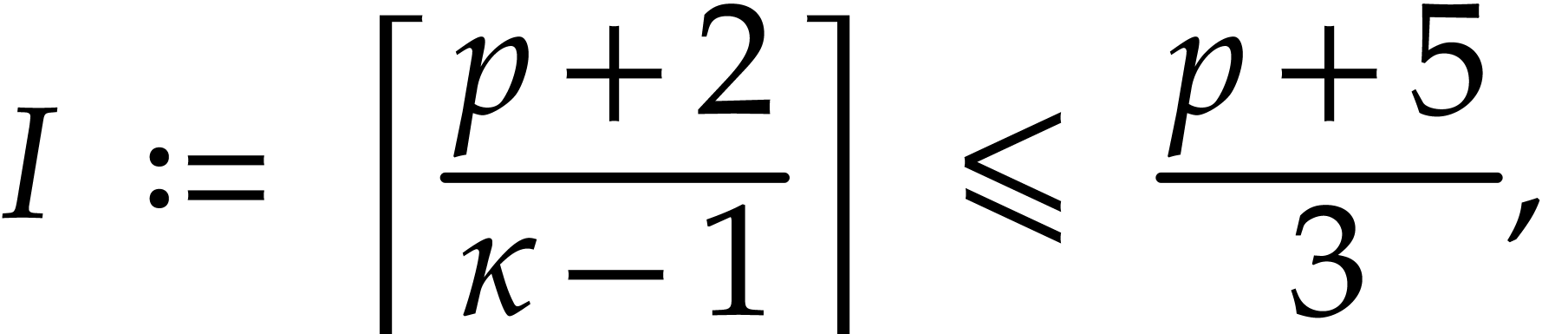
since 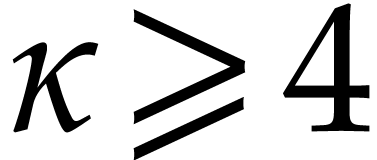 . Note that
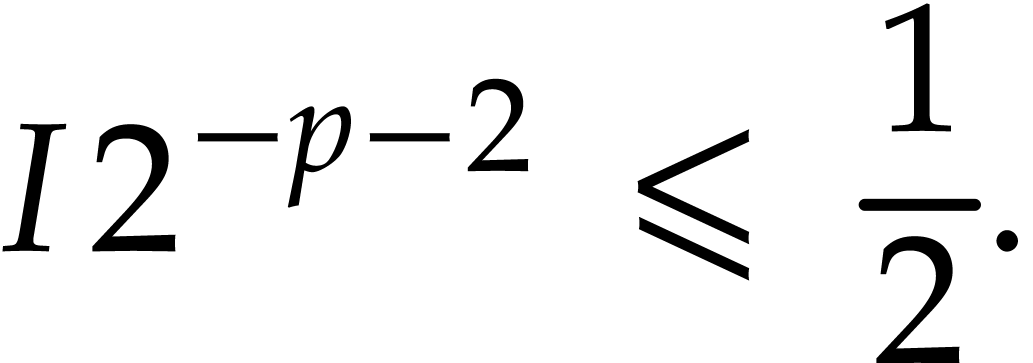 |
(5) |
We take 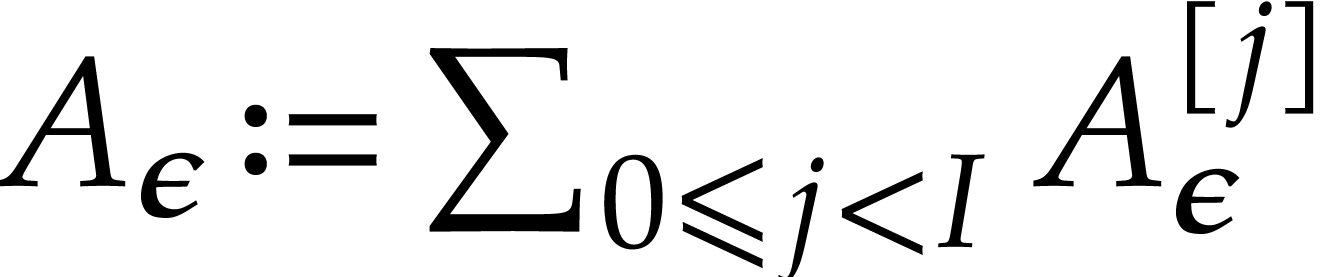 and verify that
Finally, we obtain
As for the complexity, one product  takes time
 , and
, and 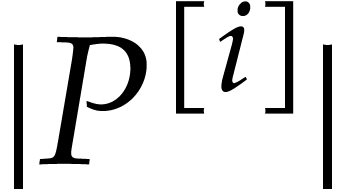 is computed with error
 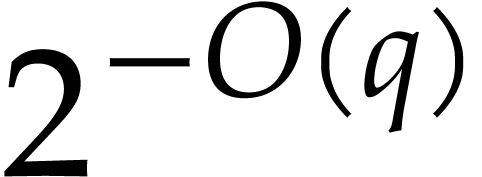 .
Consequently, the computation of from runs in time
.
Consequently, the computation of from runs in time

Each use of Proposition 9 contributes  . Since
 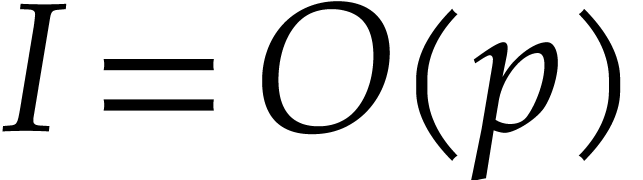 ,
the total cost for computing and up to index
,
the total cost for computing and up to index  is
is  .
.
The numerical convergence of the method behind Lemma 16 is linear, which is sufficient for small precisions. For higher precisions, our next faster algorithm benefits from the “divide and conquer” paradigm. In order to upper bound the norms of the extended reductions, we introduce the auxiliary notation

Note that 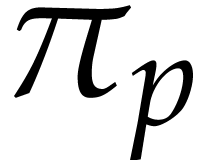 is nondecreasing in
 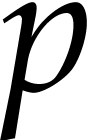 and that
  for all .
Algorithm
If  then return the extended reduction
from Lemma 16.
then return the extended reduction
from Lemma 16.
Compute a truncation  of
with error
of
with error  using Lemma 3.
Apply Algorithm 2 recursively to
using Lemma 3.
Apply Algorithm 2 recursively to 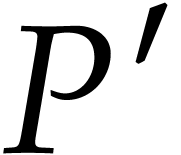 and let denote the result.
Compute a truncation  of
of
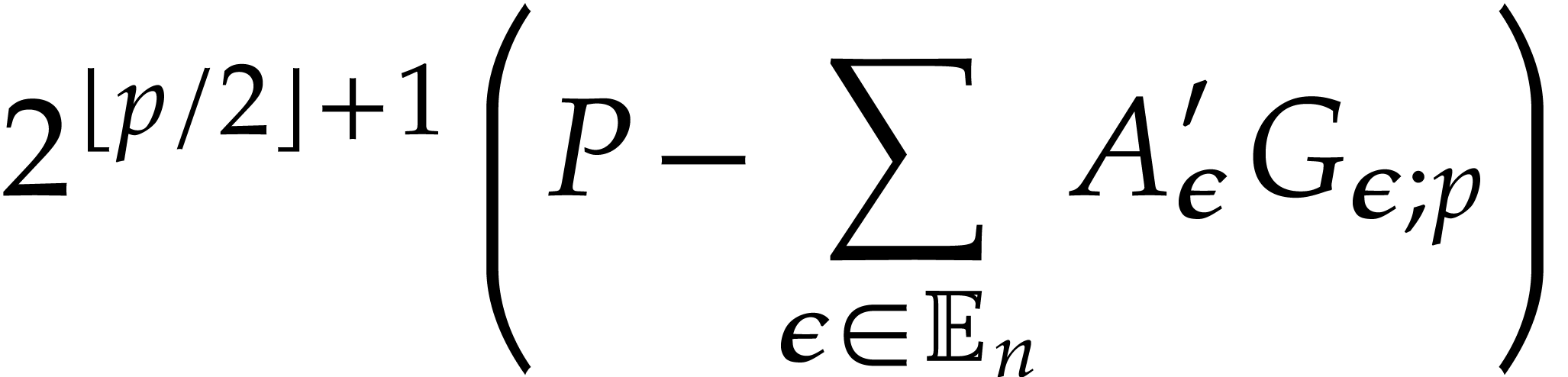
with error  . Apply
Algorithm 2 recursively to
. Apply
Algorithm 2 recursively to 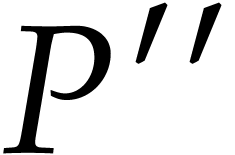 and let denote the result.
Return a truncation of  with error
 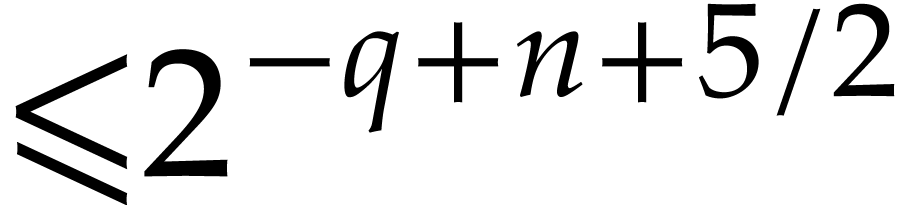 , by using Lemma 3.
Proof. If 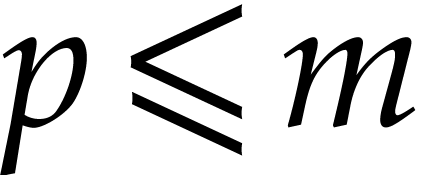 then the
output is correct in step 1 by Lemma 16. Otherwise
then the
output is correct in step 1 by Lemma 16. Otherwise 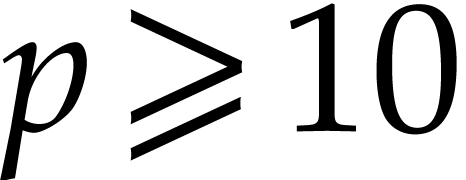 , so that
  and
and  . Consequently, the
algorithm always terminates. In step 2, by induction, we have
. Consequently, the
algorithm always terminates. In step 2, by induction, we have

We verify that
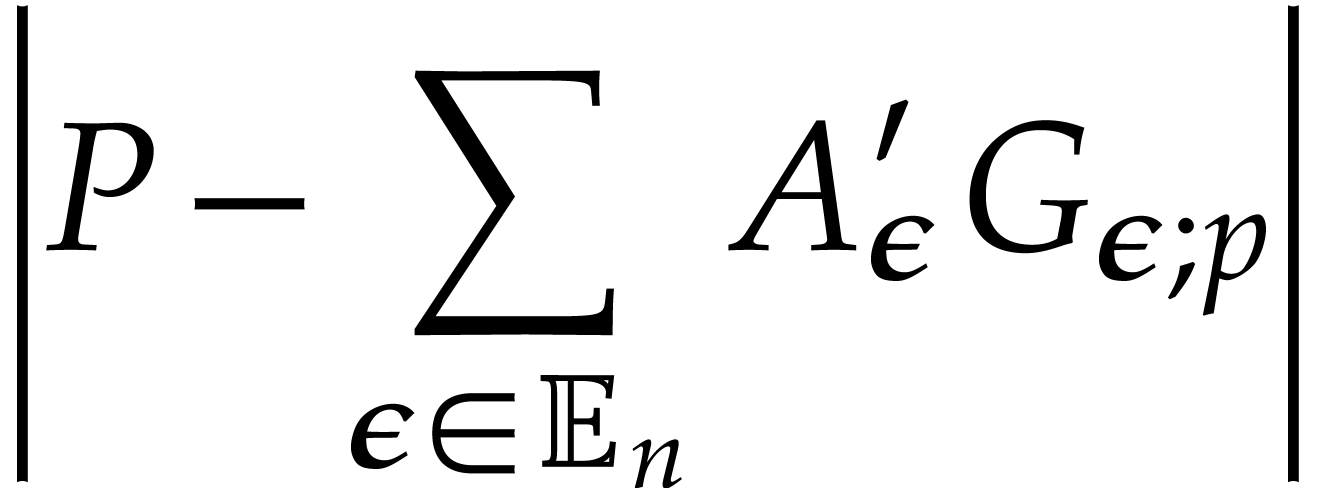 |
|
 |
|
|
 |
||
|
 |
||
|
 |
(since  ) ) |
|
|
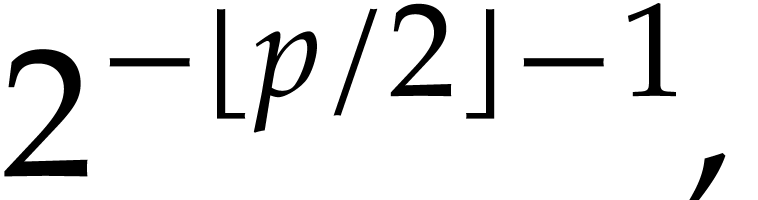 |
(since 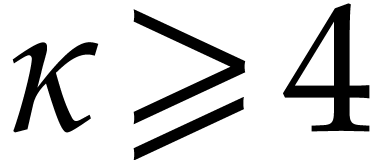 ) ) |
so the polynomial is well defined in step 3, and
we have

Let be a truncation of  with error . On the one hand,
On the other hand, we obtain
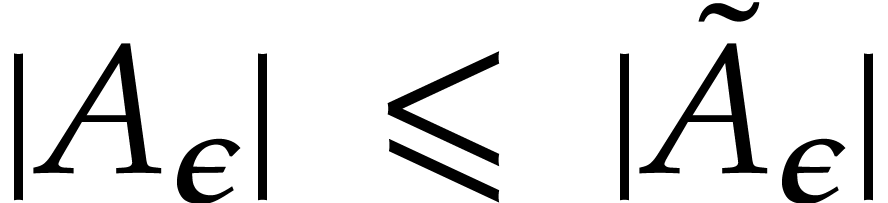 |
|
 |
|
|
 |
||
|
 |
||
|
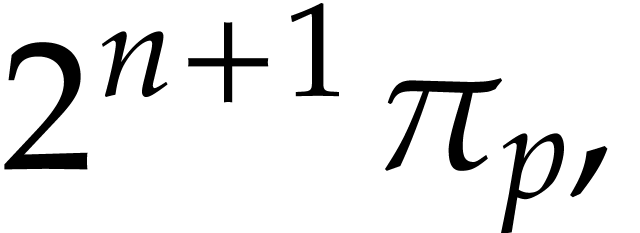 |
(since ) |
which yields
 |
(8) |
Combining
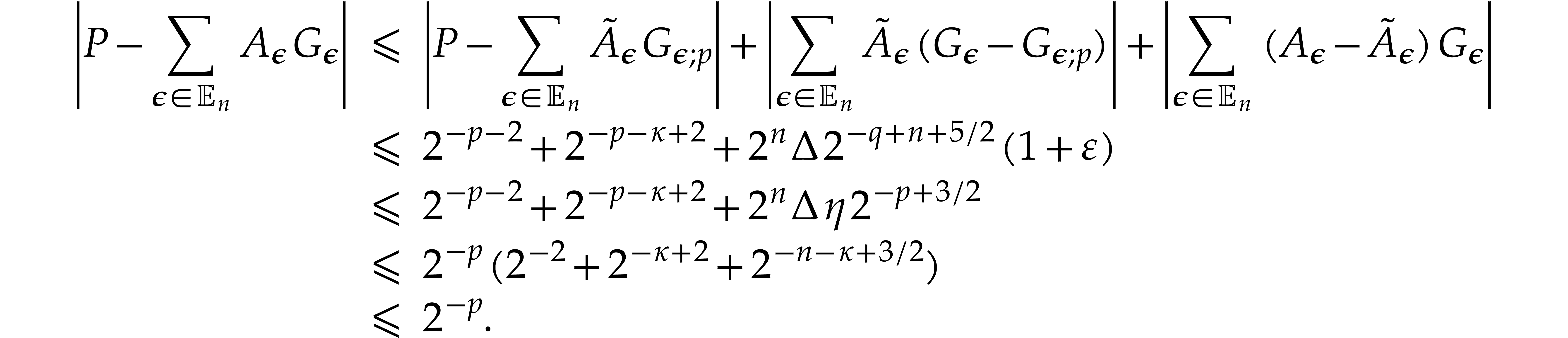
This concludes the proof of the correctness of the algorithm. Let us now analyze the complexity. By Lemma 16, step 1 contributes

Each product 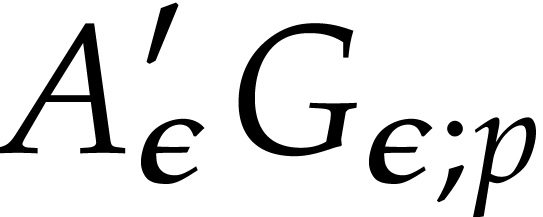 can be computed in time

The total cost to obtain is therefore bounded by

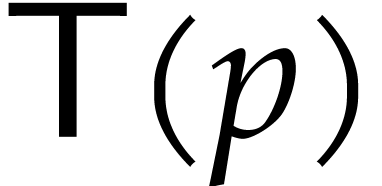
Let 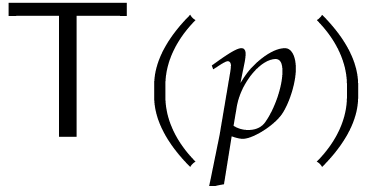 be the computation time as a function of
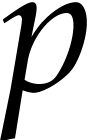 . So far, we have shown that

for 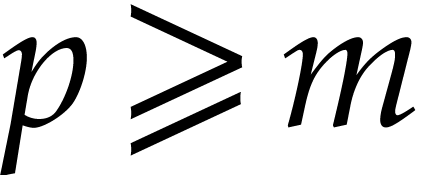 . Unrolling this
inequality leads to
. Unrolling this
inequality leads to
 |
|
 |
|
|
 |
||
|
 |
|
The following corollary is the main result of this section.
Proof. Proposition 17 allows us to compute

such that  for some
 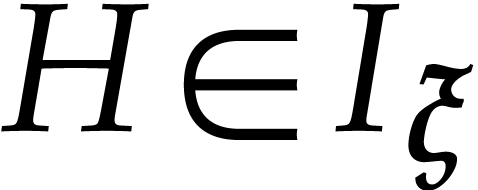 .
Using Proposition 15, we deduce that
.
Using Proposition 15, we deduce that

Using Lemma 2, we finally compute an approximation of 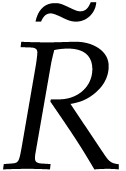 in
in  with error
 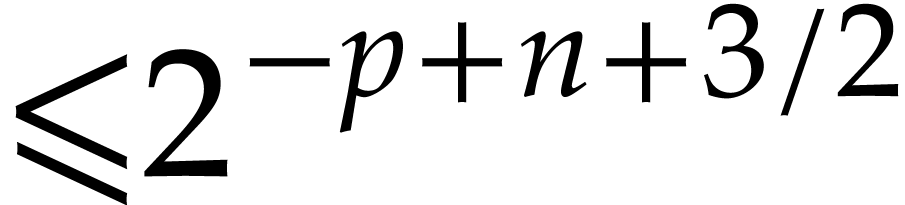 and verify that

This section is devoted to multi-point evaluation and interpolation at a spiroid. Evaluation will follow the classical “divide and conquer” paradigm with respect to the number of evaluation points. Interpolation will reduce to evaluation.
Let be as in the previous section. If  for some
 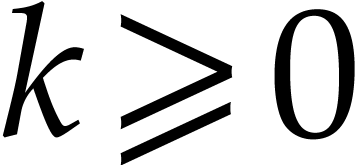 , then

Without loss of generality, this allows us to replace
by 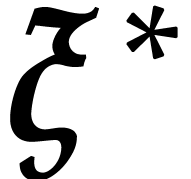 of dimension
 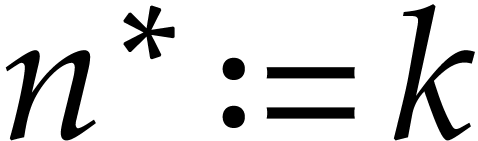 with
with
 for each .
In what follows, we will only work with spiroids
for which
for each .
In what follows, we will only work with spiroids
for which 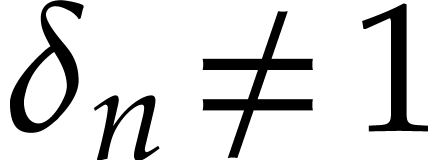 whenever .
Our algorithm for multi-point evaluation of a polynomial at is based on a generalization of
the classical remainder tree technique used for the univariate case [5, Chapter 10]. If 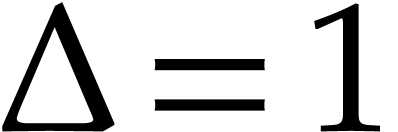 ,
then an evaluation tree for consists of
a single leaf labeled by
,
then an evaluation tree for consists of
a single leaf labeled by 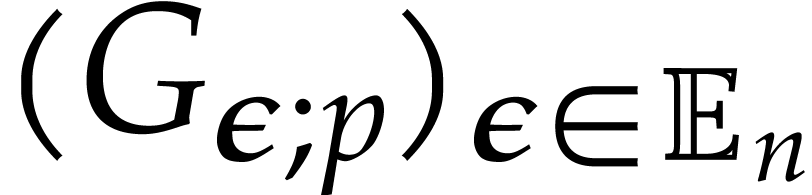 . If
. If
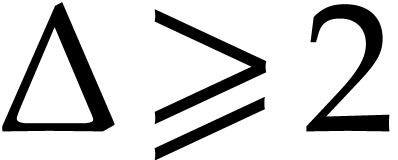 and
and 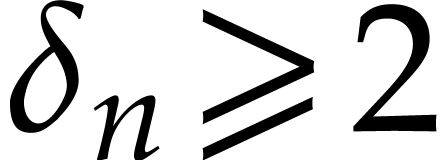 ,
then induces two sequences of points
,
then induces two sequences of points 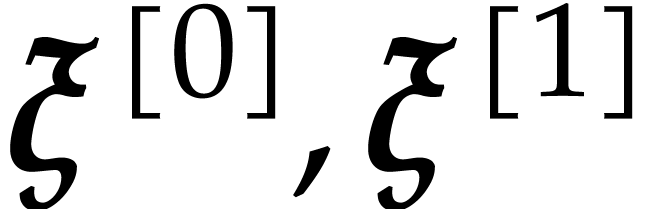 which are defined by
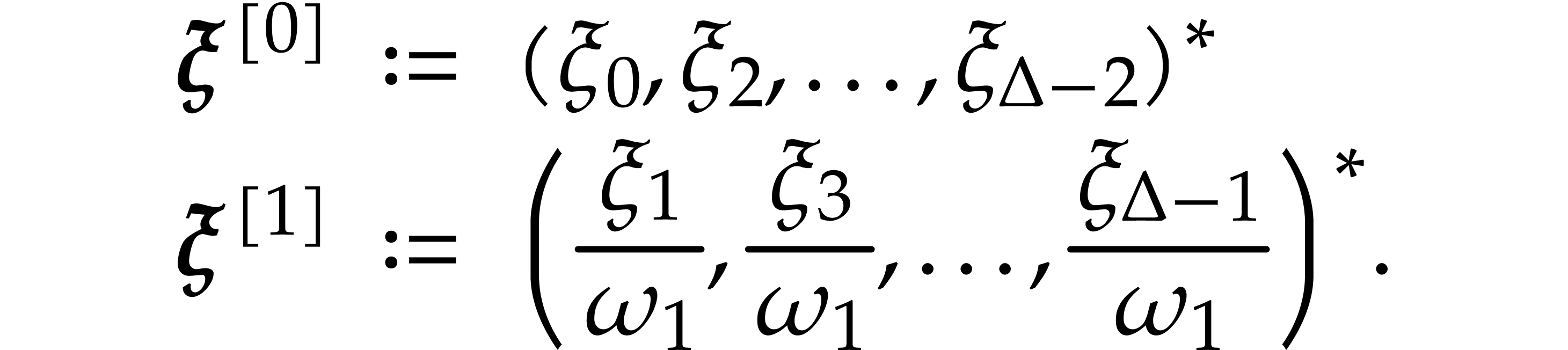
For 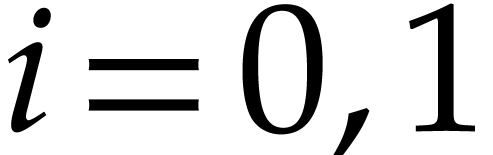 , we write
 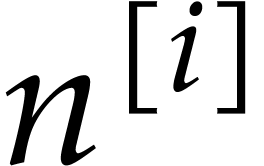 for the dimension of
 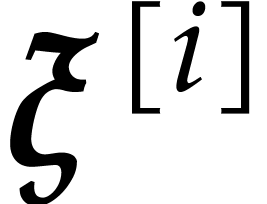 ,
,
 for its partial degrees, and
 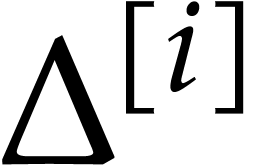 for its degree. The perturbations of the defining polynomials of are written
  ,
so we have
,
so we have

for all 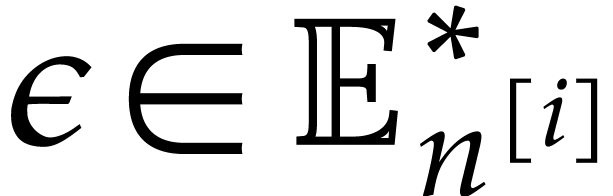 . We further define

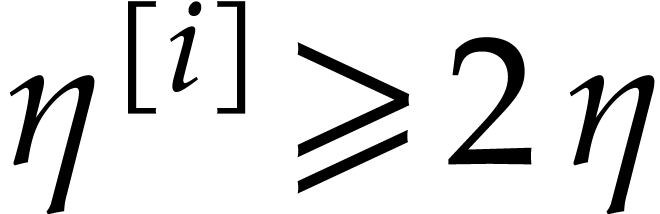
Note that 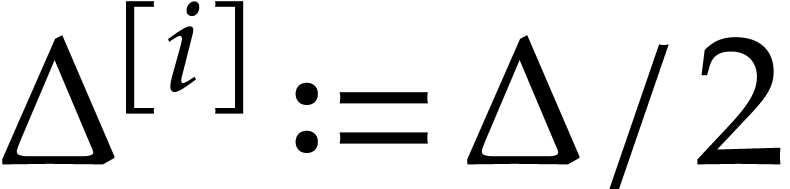 ,
,  , and
, and 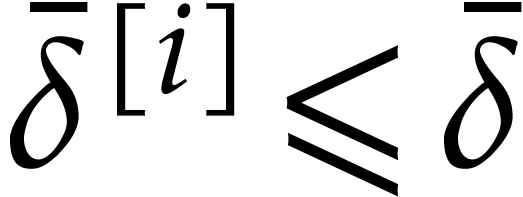 , for .
An evaluation tree for the spiroid
consists of a root that is labeled by the family
and two children which are recursively the evaluation trees for 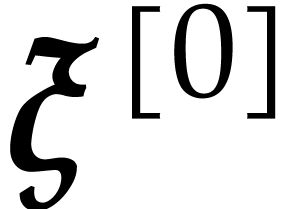 and
and  .
Since
.
Since  , if
, if 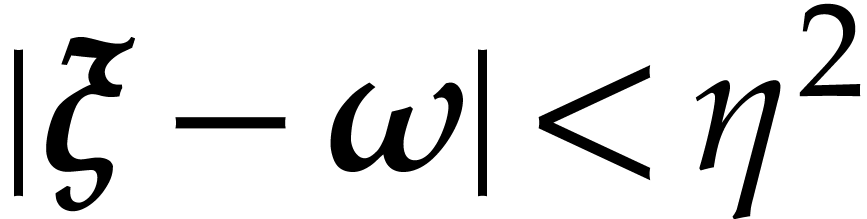 then
then  . So, Proposition 14 ensures that the
 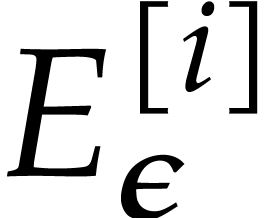 exists with
  , whenever
 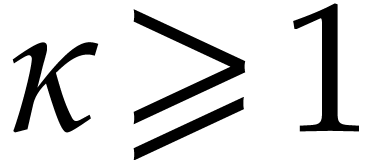 . This shows that evaluation trees exist whenever
is sufficiently small. The construction of these
trees is postponed to the end of this section.
. This shows that evaluation trees exist whenever
is sufficiently small. The construction of these
trees is postponed to the end of this section.
An evaluation tree for is said to be known
with error if 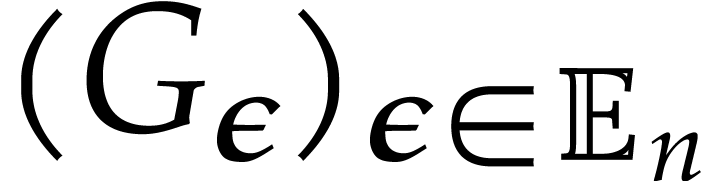 is given with error , and if
the evaluation tree for is known with error
is given with error , and if
the evaluation tree for is known with error 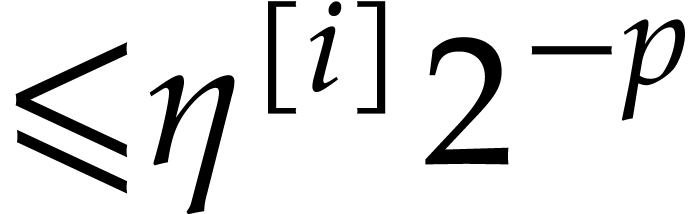 for . We
will see in section 4.3 that for such an evaluation tree
with error , the
for . We
will see in section 4.3 that for such an evaluation tree
with error , the 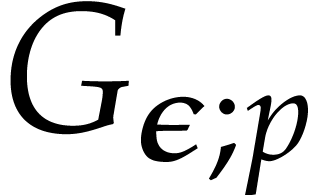 will be elements of
  with
with  . Our next algorithm performs fast
evaluation at by taking advantage of evaluation
trees.
. Our next algorithm performs fast
evaluation at by taking advantage of evaluation
trees.
Algorithm
If then return an approximation of 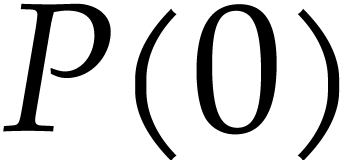 in
in 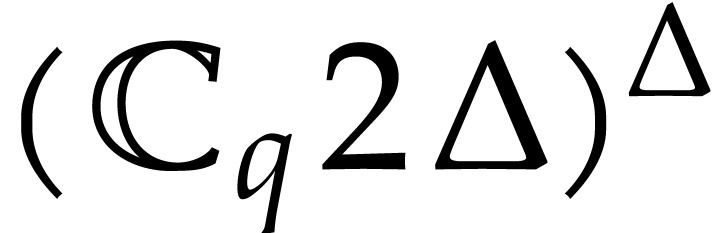 with error
 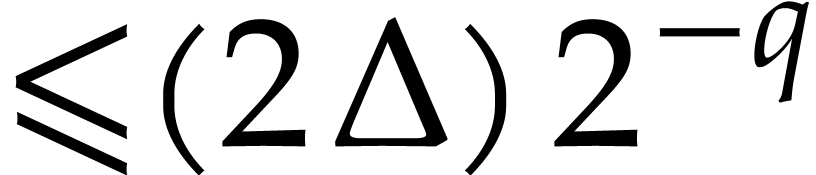 , by using Lemma 2.
Compute a truncation  of
of 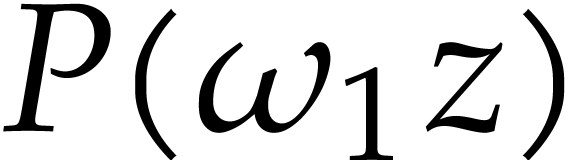 with error
  .
.
Compute truncations 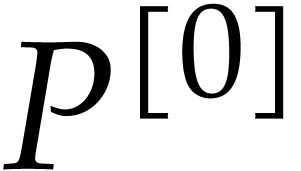 and
and 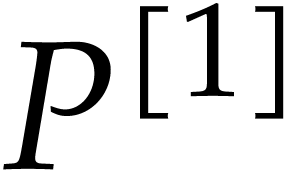 of
of 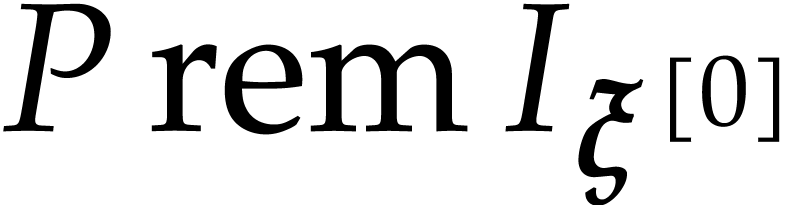 and
and 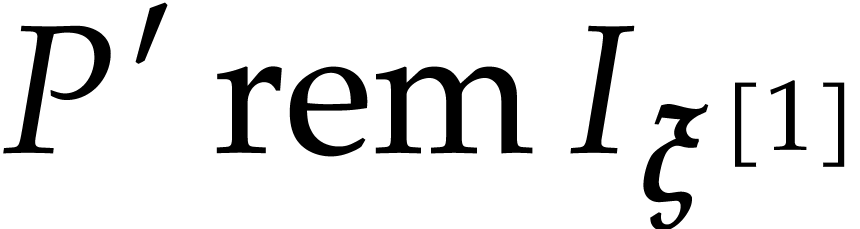 in
in  with error
 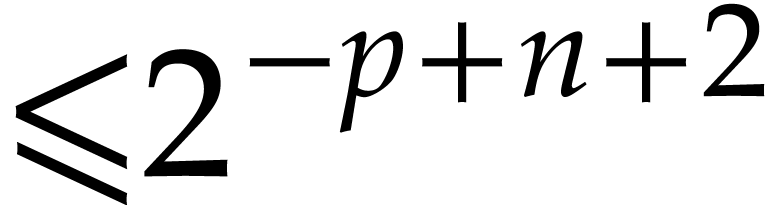 via
Corollary 18.
via
Corollary 18.
Apply Algorithm 3 recursively to 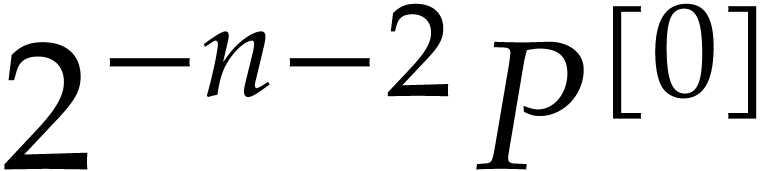 and the evaluation sub-trees for in
order to obtain approximations
and the evaluation sub-trees for in
order to obtain approximations  of
of  with error
 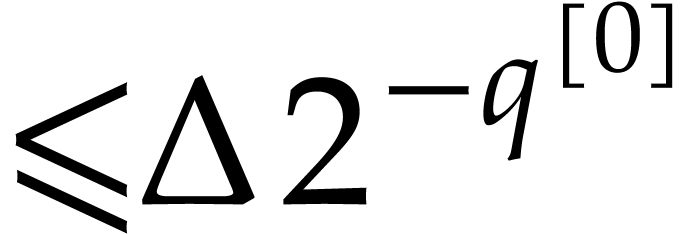 ,
where
,
where  .
.
Apply Algorithm 3 recursively to 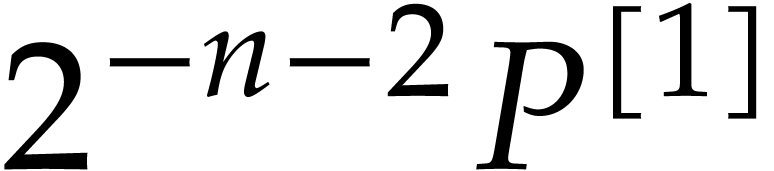 and the evaluation sub-trees for in
order to obtain an approximation
and the evaluation sub-trees for in
order to obtain an approximation  of
of  with error
 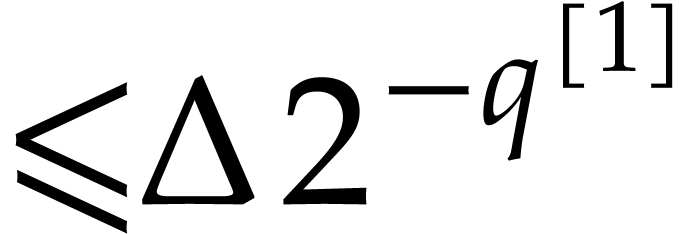 ,
where
,
where  .
.
Return an approximation of  in with error .
Proof. If 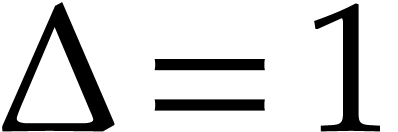 then the
algorithm behaves as expected. Let us now assume that . The correctness mostly relies on the
identities
then the
algorithm behaves as expected. Let us now assume that . The correctness mostly relies on the
identities

for  . Let us verify that
computations are done with sufficiently large precisions. By
construction, we have
. Let us verify that
computations are done with sufficiently large precisions. By
construction, we have  and
and  . Corollary 18 yields
 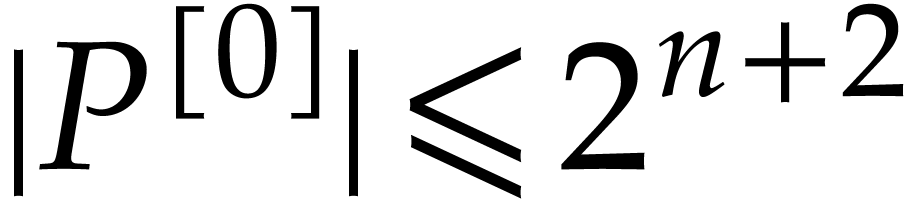 ,
, 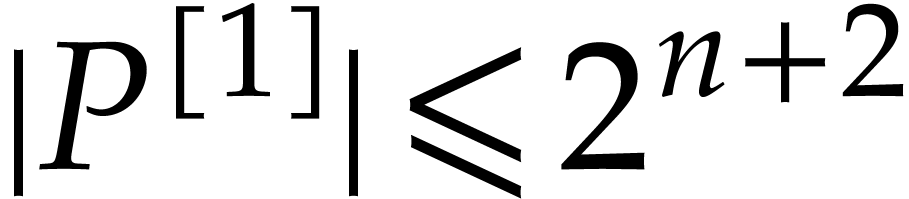 and
and

Since 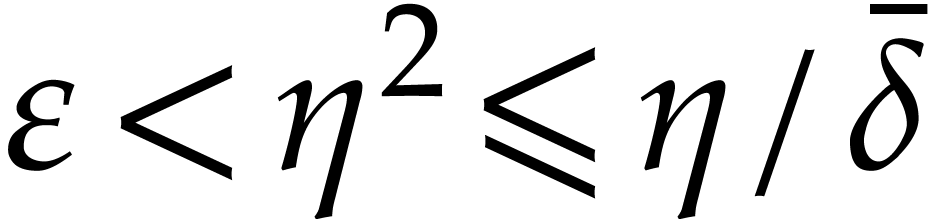 , Lemma 12
ensures that
, Lemma 12
ensures that
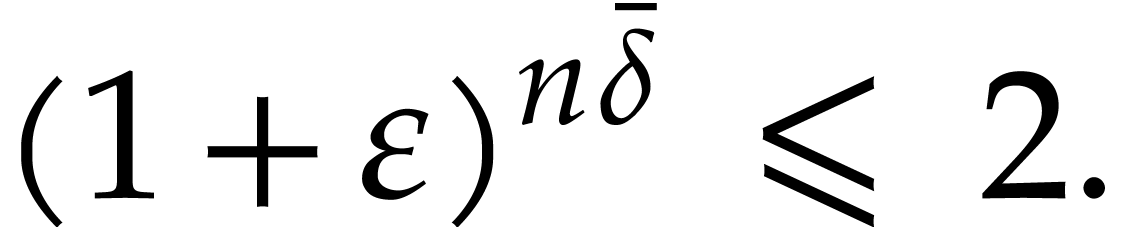 |
(9) |
In particular, it follows that 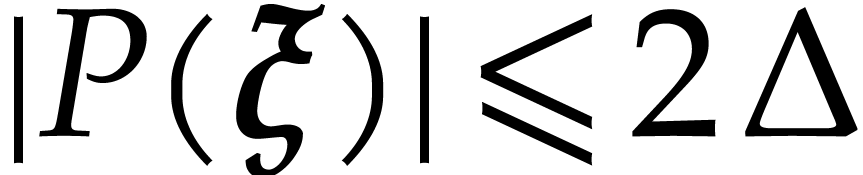 .
Assuming by induction that the claimed properties hold for the recursive
call in step 4, we obtain
.
Assuming by induction that the claimed properties hold for the recursive
call in step 4, we obtain
 |
|
 |
|
|
 |
||
|
 |
(using |
|
|
 |
(since ) |
|
|
 |
Similarly, for 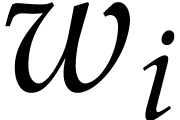 we obtain
 |
|
 |
|
 |
|||
 |
|||
|
 |
||
|
 |
(using |
|
|
 |
(since ) |
|
|
|
We are done with the correctness. As for the complexity analysis, the
computation of  and then of
 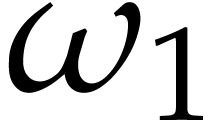 , with bits of
precision in step 2 can be done in time
, with bits of
precision in step 2 can be done in time 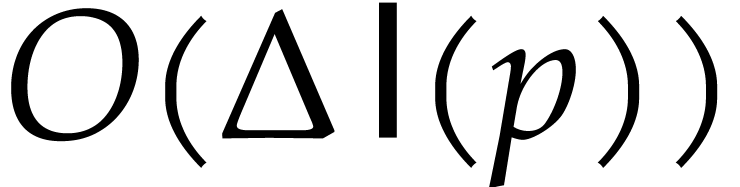 by Lemma
4, under the assumption
by Lemma
4, under the assumption  .
Therefore, step 2 runs in time .
In view of Corollary 18, the complexity
.
Therefore, step 2 runs in time .
In view of Corollary 18, the complexity  of Algorithm 3 satisfies

for some universal constant 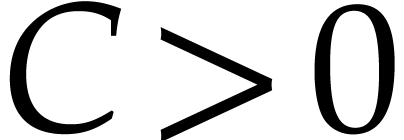 .
Unrolling this inequality, we obtain
.
Unrolling this inequality, we obtain

Unrolling this new inequality, while using the geometric increase of
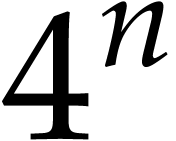 , we obtain the desired
complexity bound.
, we obtain the desired
complexity bound.
Our interpolation algorithms rely on the evaluation one. We begin with a method dedicated to small precisions.
Proof. Using Lemma 5, we compute
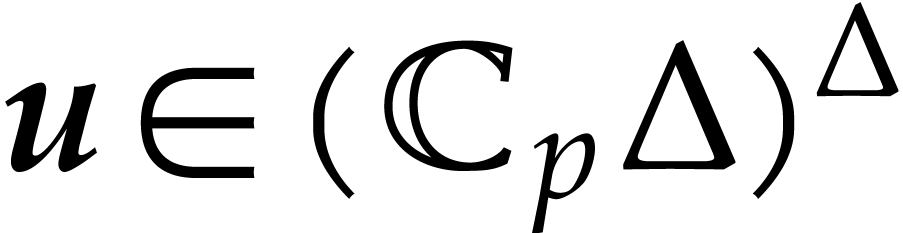 such that
 |
(10) |
and 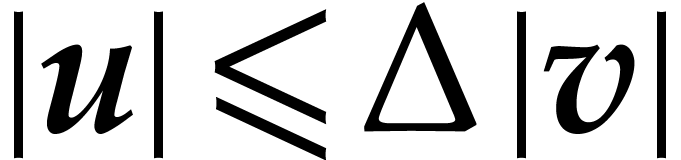 in time
  .
For we take the unique polynomial of
.
For we take the unique polynomial of  such that

so we have  . Finally
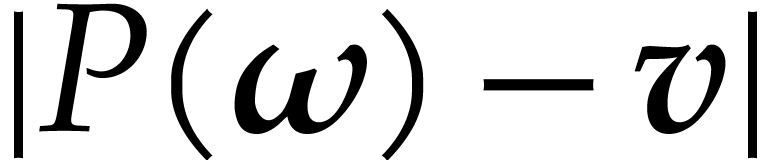 |
|
 |
|
|
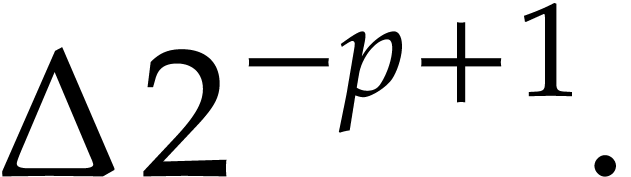 |
|
, 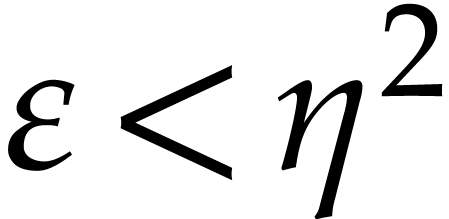 , and
, and  .
Given an evaluation tree for with error for
.
Given an evaluation tree for with error for 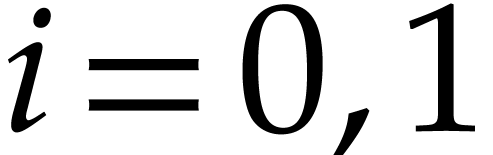 ,
and
,
and 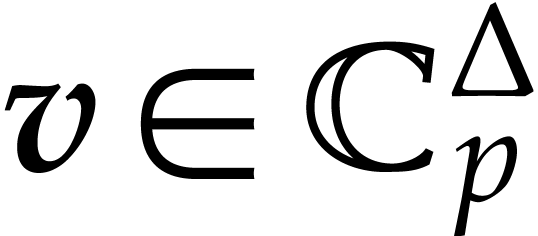 , we can compute
  such that

in time  .
.
Proof. Let  .
By induction, we construct sequences
.
By induction, we construct sequences 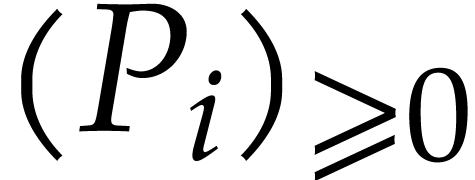 and
and 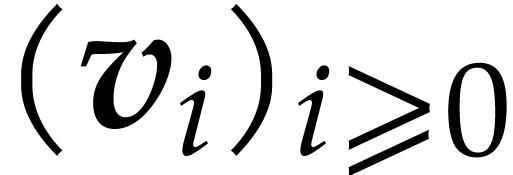 such that
  and
and 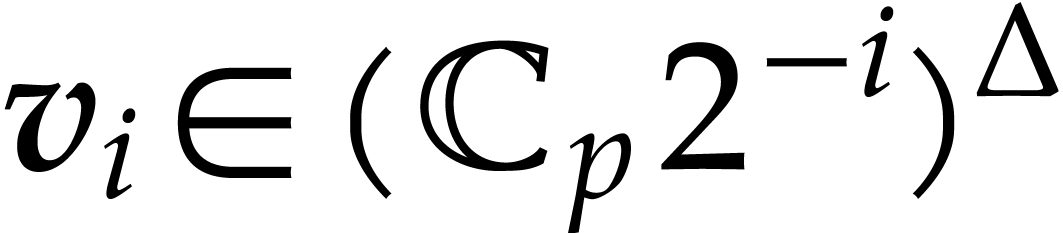 . We set
 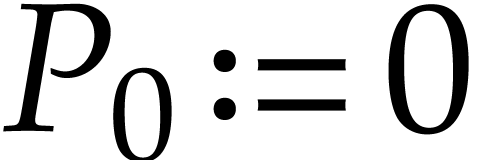 and . For ,
we first compute
and . For ,
we first compute  as the polynomial interpolated
from
as the polynomial interpolated
from 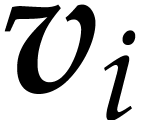 by inverse FFT as in Lemma 20,
so we have
by inverse FFT as in Lemma 20,
so we have 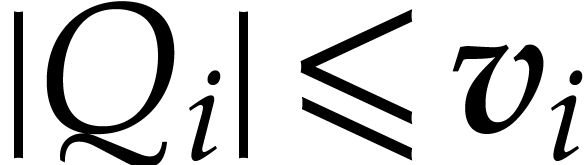 and
and  .
Using Algorithm 3, we then compute an approximation
.
Using Algorithm 3, we then compute an approximation  of
of 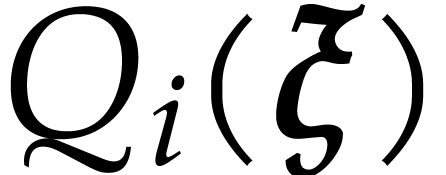 with error

Using Lemma 3, we next compute a truncation 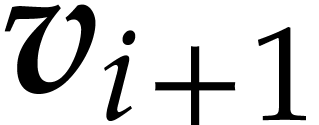 of
of 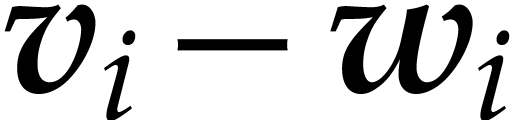 with error
 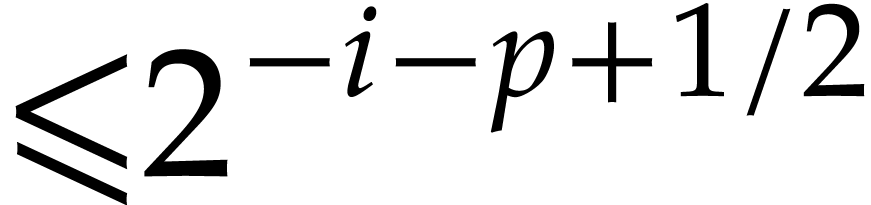 . Then
Using Lemmas 11 and 12, we obtain
 |
|
 |
|
|
 |
(using |
|
|
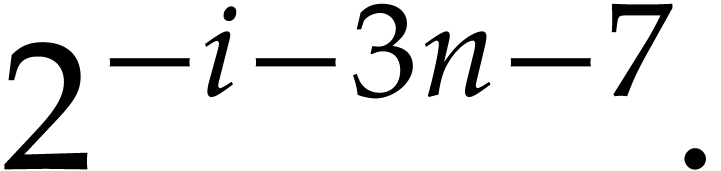 |
It follows that
so the sequence converges to . We define  and verify
that
and verify
that
 |
|
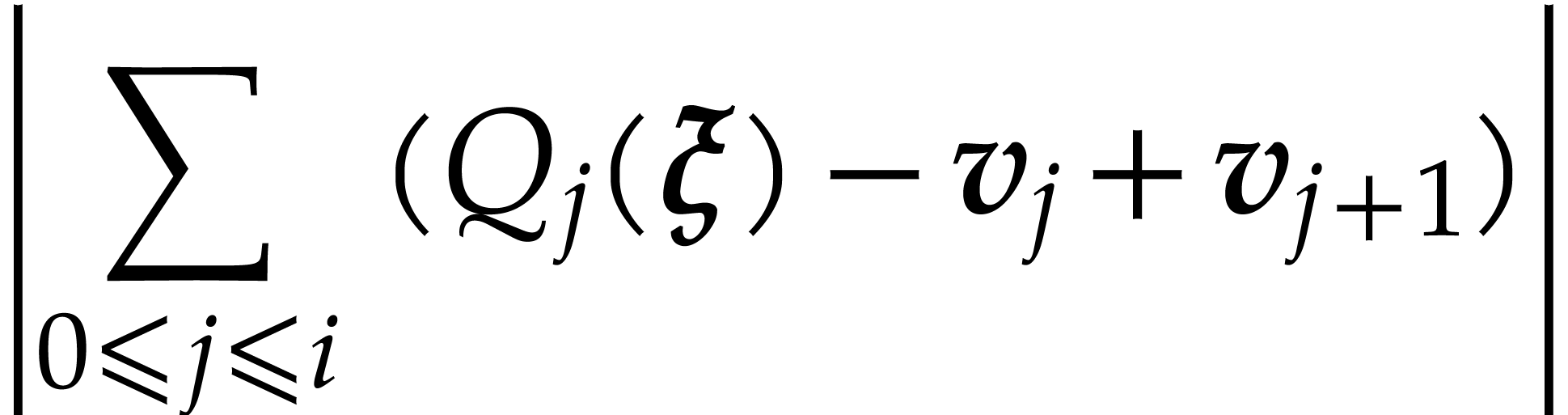 |
|
|
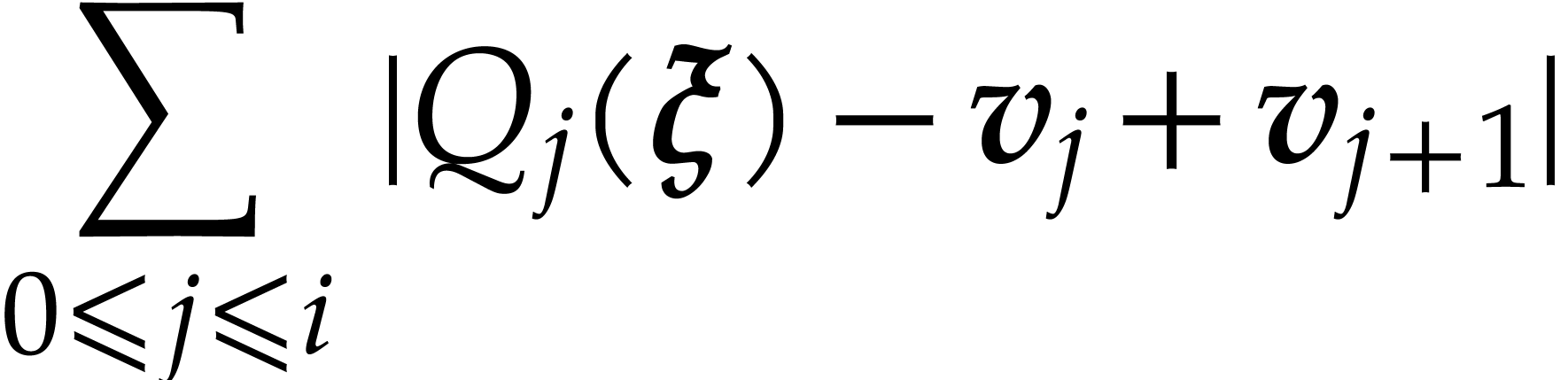 |
||
|
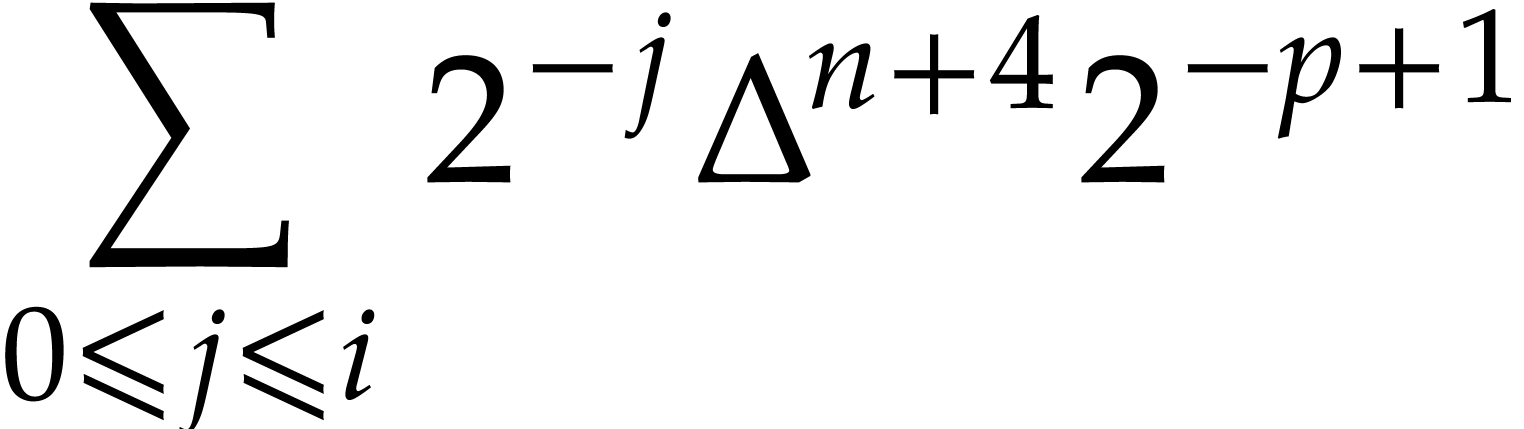 |
(using |
|
|
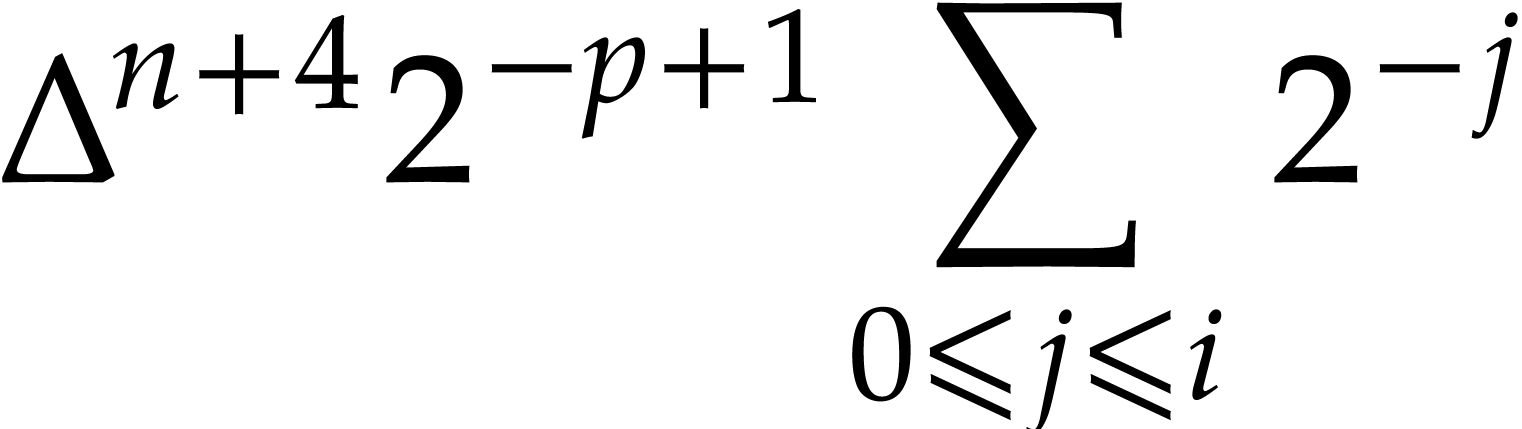 |
||
|
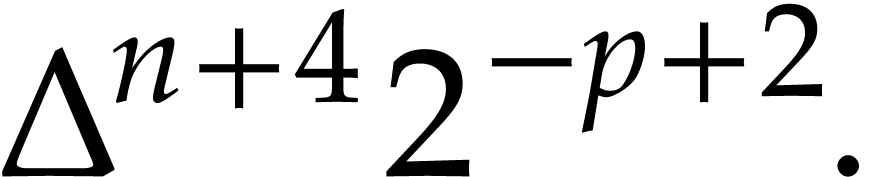 |
On the other hand, we have  .
We take
.
We take  minimal such that

so we have . Let be a truncation of 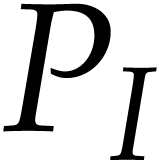 with error
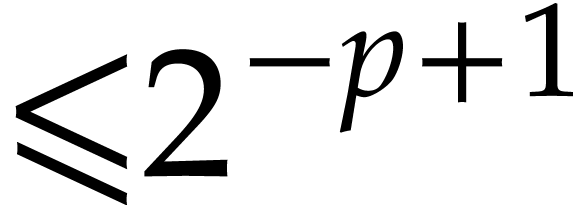 . Then
Finally, Lemma 20 asserts that each 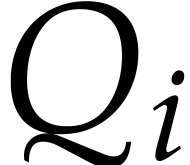 can be computed in time
 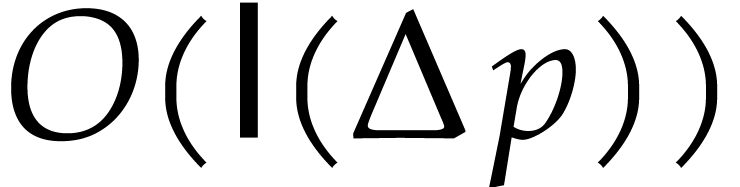 . By
Proposition 19, each
. By
Proposition 19, each 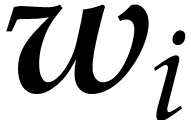 is obtained in
time
is obtained in
time  .
.
The next faster algorithm exploits the usual “divide and
conquer” paradigm for large precisions .
Algorithm
If  then compute
  such that
  via Lemma 21.
Return an approximation of in
via Lemma 21.
Return an approximation of in  with error
 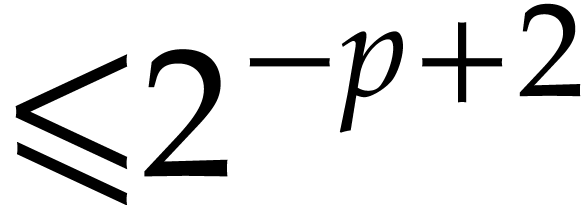 , by using Lemma 2.
Let 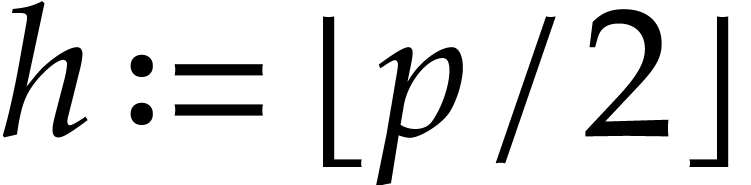 and
and  and let
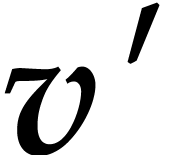 be a truncation of
 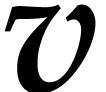 in
in 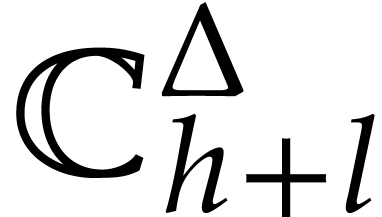 with error
 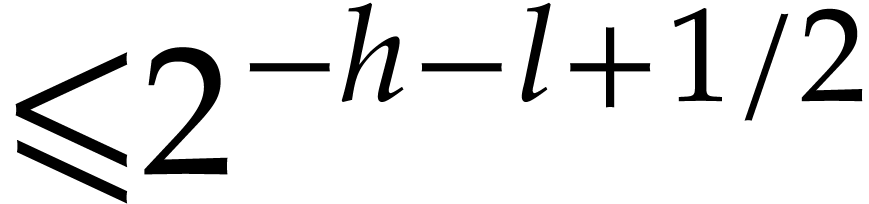 . Apply Algorithm 4 recursively
to and let
. Apply Algorithm 4 recursively
to and let  denote the output.
Compute an approximation 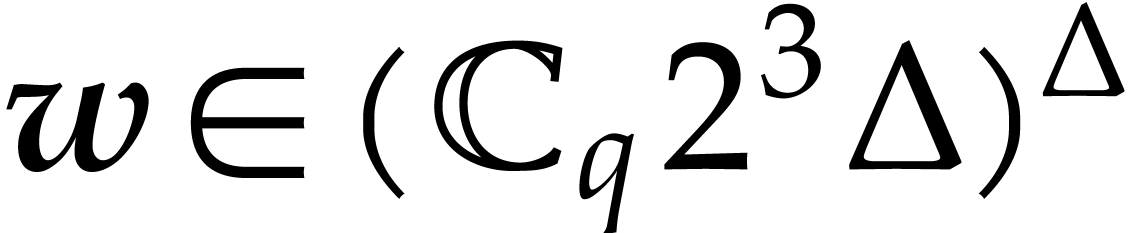 of
of 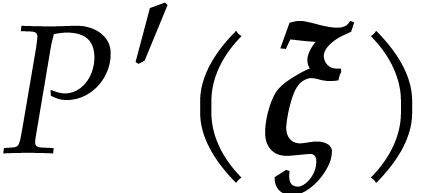 with error
  ,
by applying Algorithm 3 to
,
by applying Algorithm 3 to 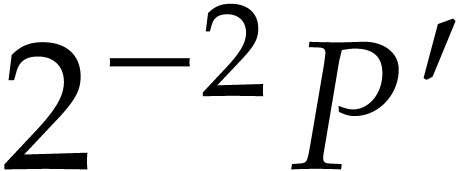 , where
Let  and compute a truncation
  of
of 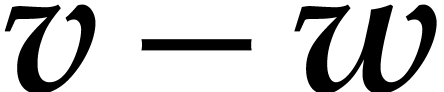 with error
  . Apply Algorithm 4
recursively to
. Apply Algorithm 4
recursively to 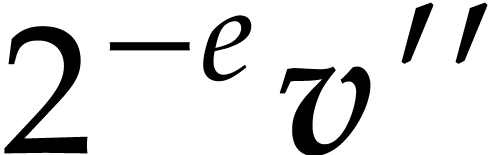 and let
  denote the output.
Return an approximation of 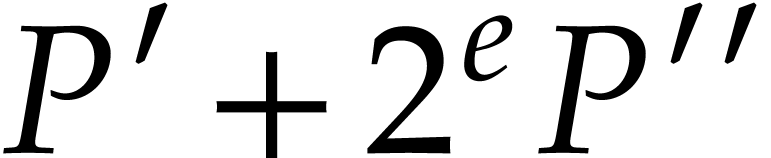 with error
.
with error
.
Proof. If ,
then  , whence
 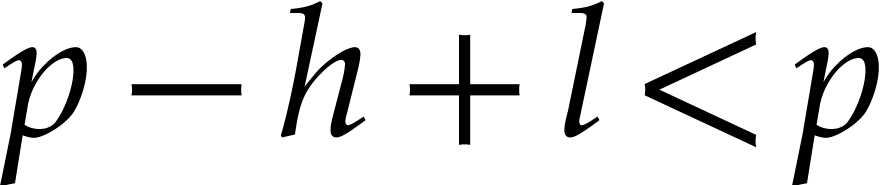 , which implies the termination of the
algorithm. In step 1 we obtain
, which implies the termination of the
algorithm. In step 1 we obtain
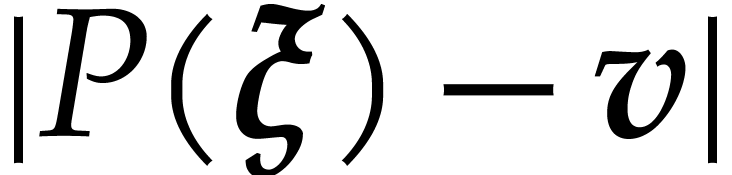 |
|
 |
|
|
 |
||
|
 |
(using |
|
|
 |
(since 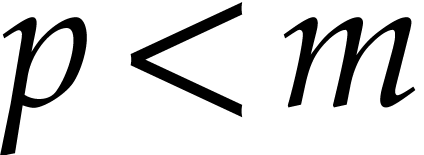 and ) and ) |
|
|
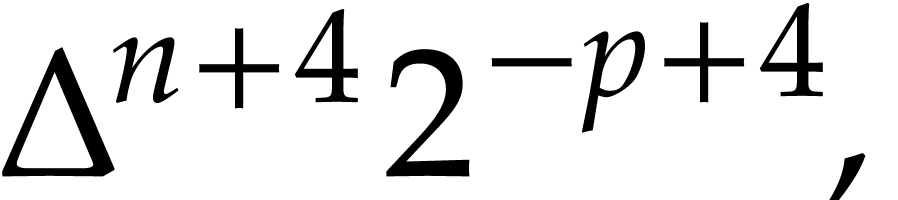 |
so the output is correct when the algorithm exits at step 1. After step 3 we have
In step 4, we note that
 |
(16) |
and deduce
Therefore, the recursive call in step 4 is valid and gives
 |
(17) |
Combining

Consequently,
|
|
 |
|
|
 |
||
|
 |
(using |
|
|
 |
(since ) |
|
|
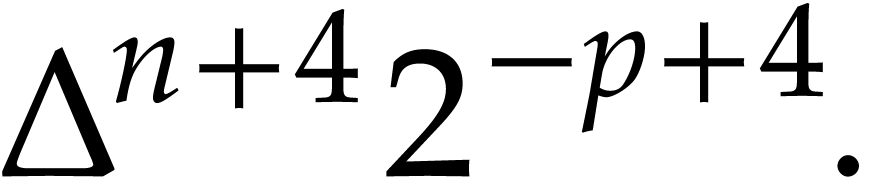 |
Step 1 takes time

by Lemma 21. Steps 3 runs in time

by Proposition 19. When ,
the complexity of our algorithm therefore
satisfies

for some universal constant .
Unrolling this inequality, we obtain

which concludes the proof.
The evaluation tree for is obtained by
induction: we recursively compute evaluation trees for
and , and deduce the one for
as follows.
Algorithm
If then return  and an approximation
 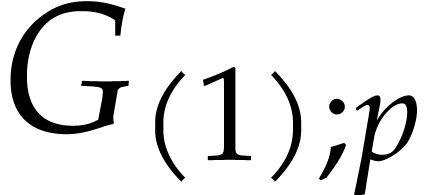 of
of  with error .
Let  . For , let
  and compute
 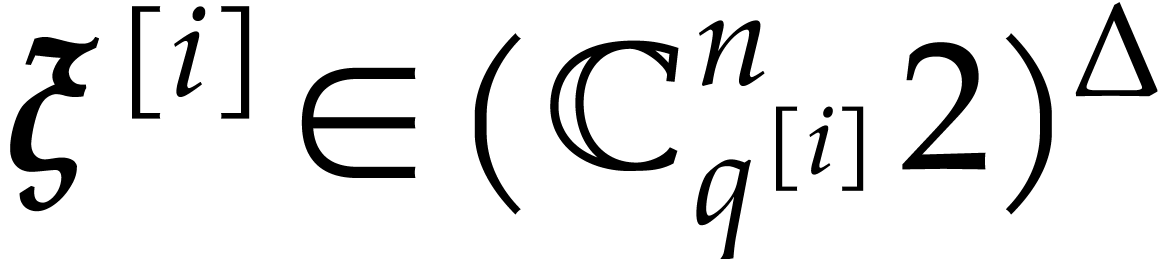 with error
 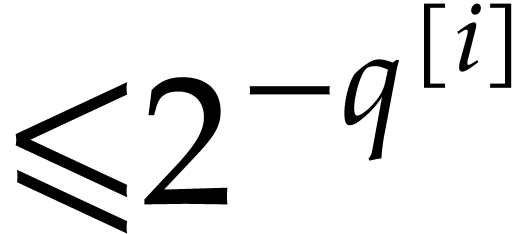 . Recursively compute the evaluation
trees
. Recursively compute the evaluation
trees 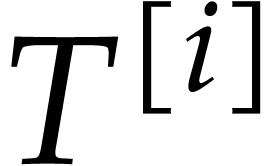 for with
error
for with
error  .
.
For each do:
Compute an approximation 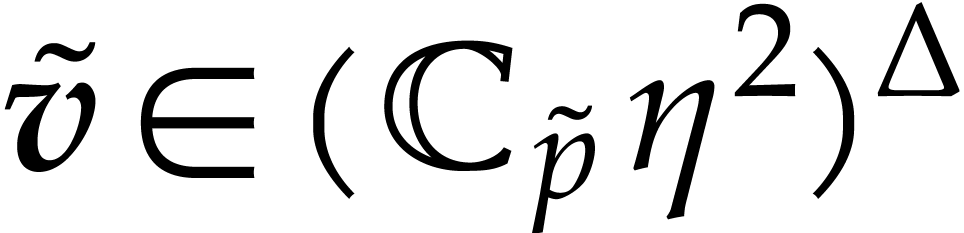 of
of 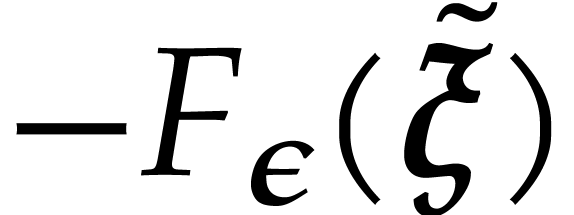 with error
 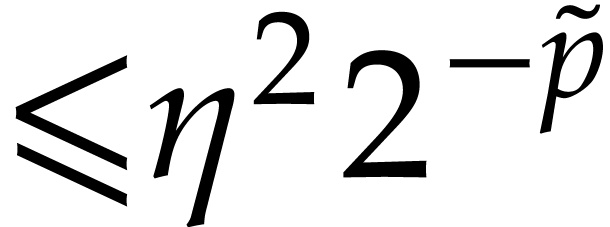 .
.
Apply Algorithm 4 to 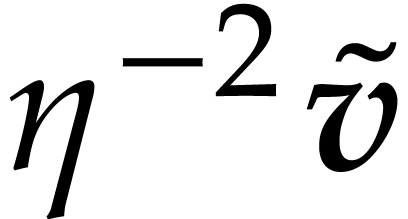 ,
, 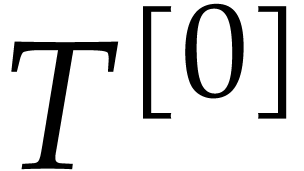 ,
,
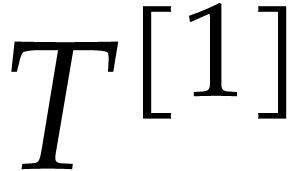 ; let
; let  be the returned polynomial, such that
  .
.
Compute an approximation  of
of 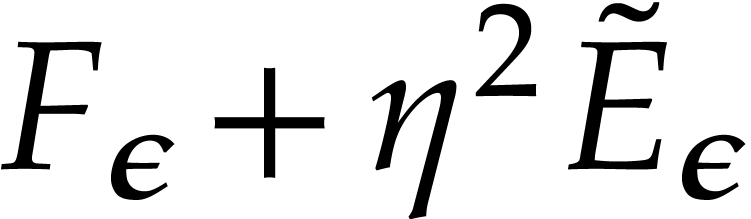 with error
 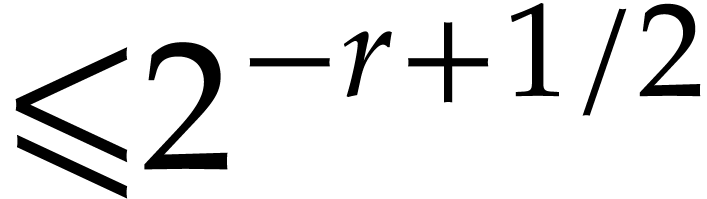 ,
where
,
where  .
.
Set and return  , and approximations of , with errors
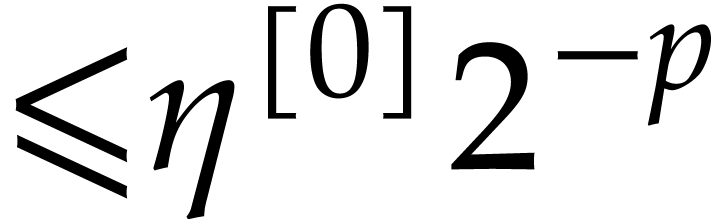 and
and 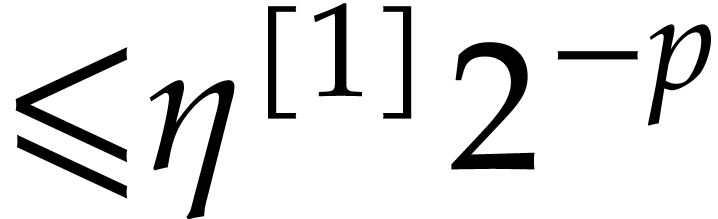 .
.
Proof. If the algorithm exits in step 1, then we
have  , so the output is
correct. Now, let us assume that and note that
, so the output is
correct. Now, let us assume that and note that
and
 |
(19) |
For , we compute 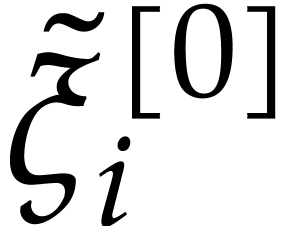 as the truncation of
 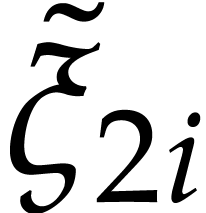 with error
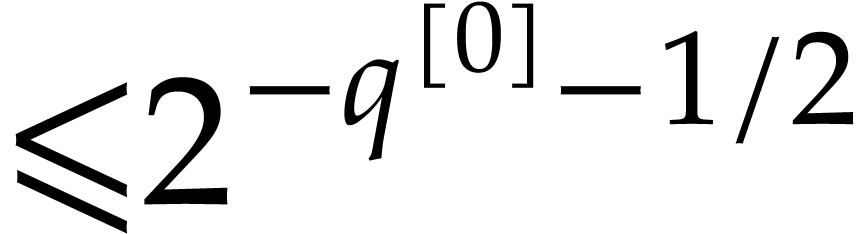 using Lemma 2. Hence,
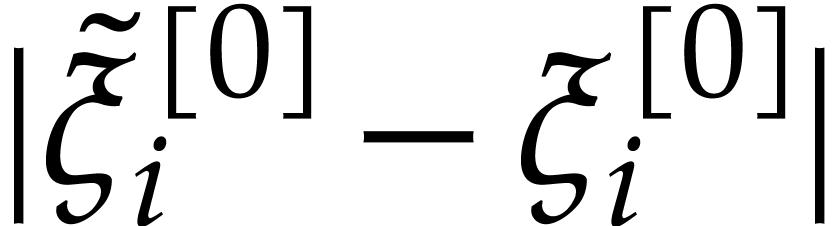 |
|
 |
|
|
 |
||
|
 |
(using |
|
|
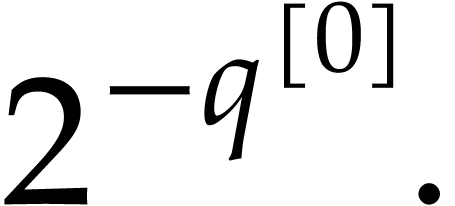 |
From Lemma 4, we may compute a truncation 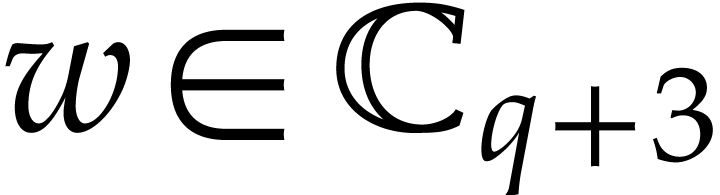 of
of 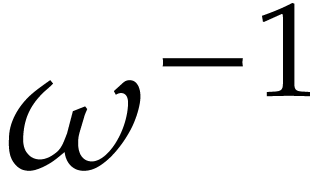 with error
  in time
, provided that
in time
, provided that  . We compute an approximation
 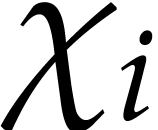 of
of  with error
 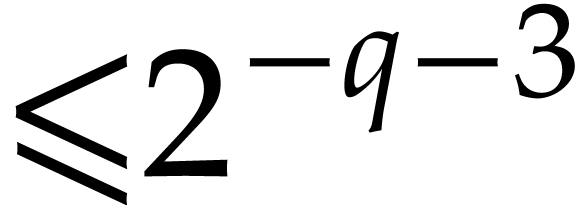 .
It follows that
.
It follows that
Using Lemma 2, we obtain 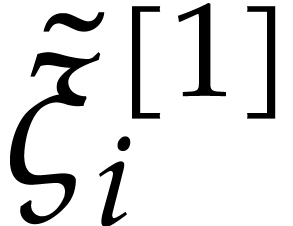 as the
truncation of with error
as the
truncation of with error 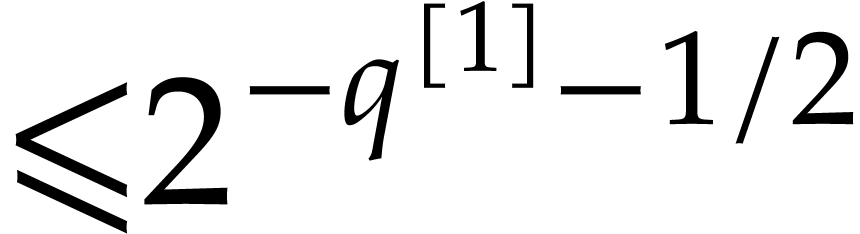 . Hence,

For step 3.a, we need to verify that
so the use of Algorithm 4 is valid in step 3.b. Thanks to
Proposition 22 and using that ,
we obtain
Lemma 13 yields  .
It follows that
.
It follows that
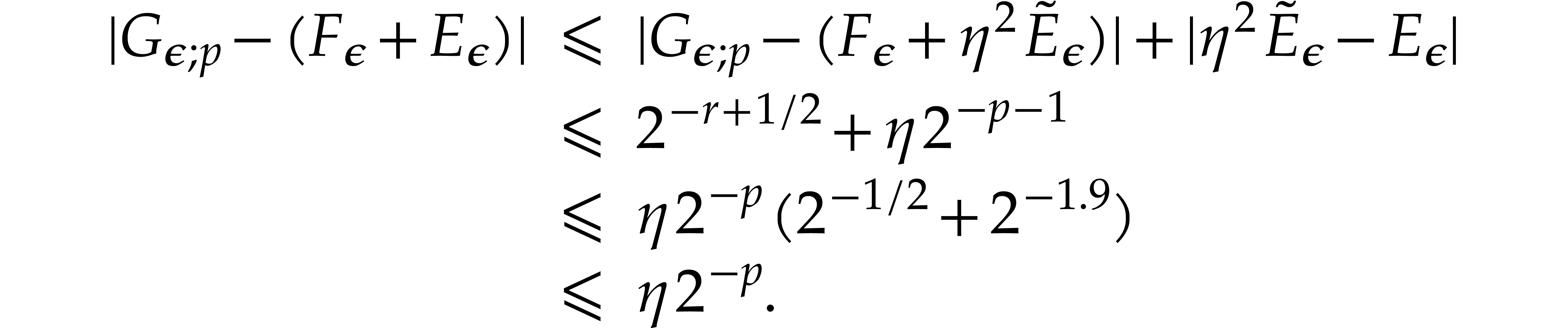
This concludes the correctness proof. As for the complexity we note that
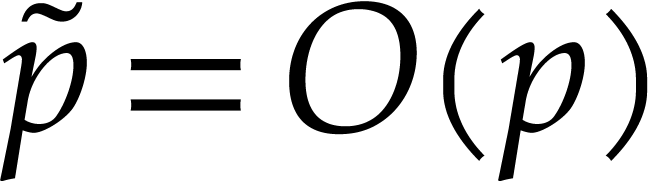 whenever .
In step 3,
whenever .
In step 3, 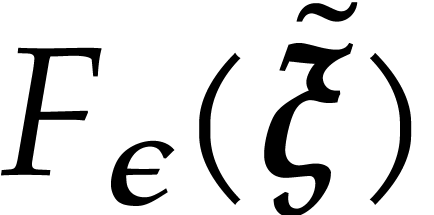 can be computed in time
  , using binary powering. In step 3.b, the
interpolation of
, using binary powering. In step 3.b, the
interpolation of 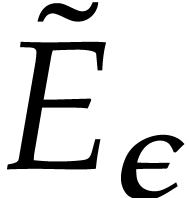 takes
takes

operations, by Proposition 22. Overall the complexity 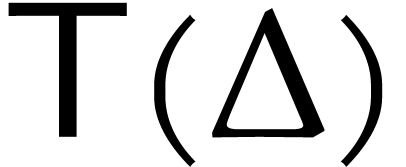 of our algorithm satisfies

for some universal constant .
Unrolling this inequality yields the claimed complexity bound.
Consider  and
and  ,
where is a positive integer. Our goal is to
compute
,
where is a positive integer. Our goal is to
compute  . We first follow
Kedlaya and Umans [14], by transforming the problem into a
multivariate one. For some
. We first follow
Kedlaya and Umans [14], by transforming the problem into a
multivariate one. For some 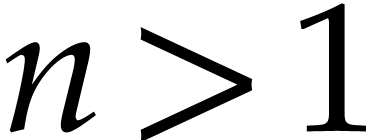 and powers of two
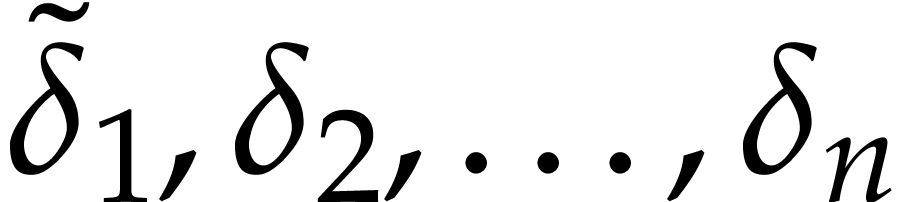 with
with  and
and  , there exists a unique lift

such that

The first degree bound 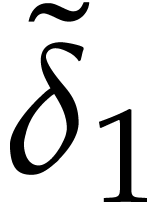 will be adjusted below to
a larger value
will be adjusted below to
a larger value 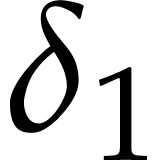 that will match the setting of
the previous section. We define
that will match the setting of
the previous section. We define

so we have
In order to compute the right-hand side of (20), we further
lift the problem into another one with integer coefficients: let  and
and  be the canonical lifts of
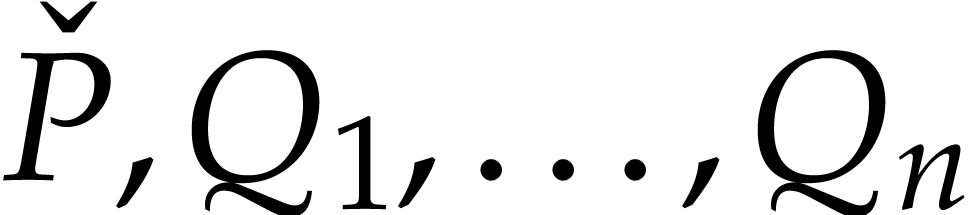 with coefficients in
  and
set
and
set

where 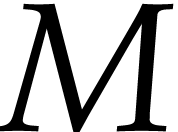 is a positive integer that will be
specified below. Note that
is a positive integer that will be
specified below. Note that 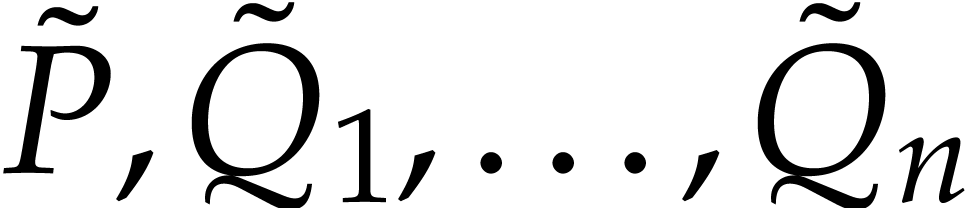 are still lifts of
, so
are still lifts of
, so

We finally rescale the polynomials, so that we can compute  using a spiroid:

Note that

and

We will evaluate
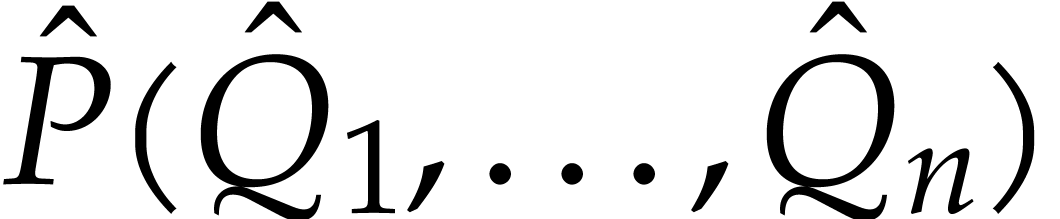
numerically using fixed point arithmetic. Setting 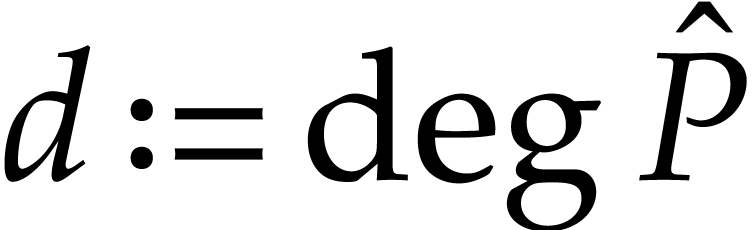 , we note that

Let be the smallest power of two satisfying
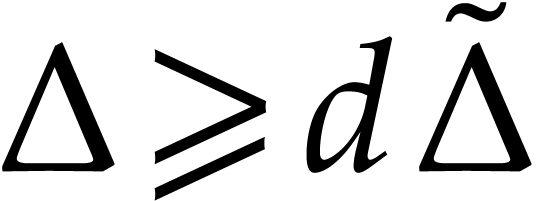 , let
, let  , and consider the standard primitive -th root of unity
  .
We wish to determine
.
We wish to determine 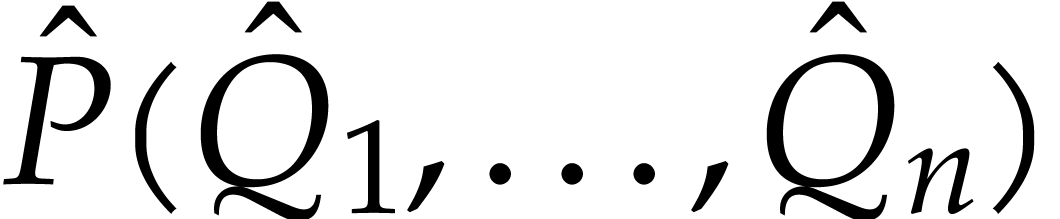 from its values at
  . For
. For  ,
we let
,
we let

so we have
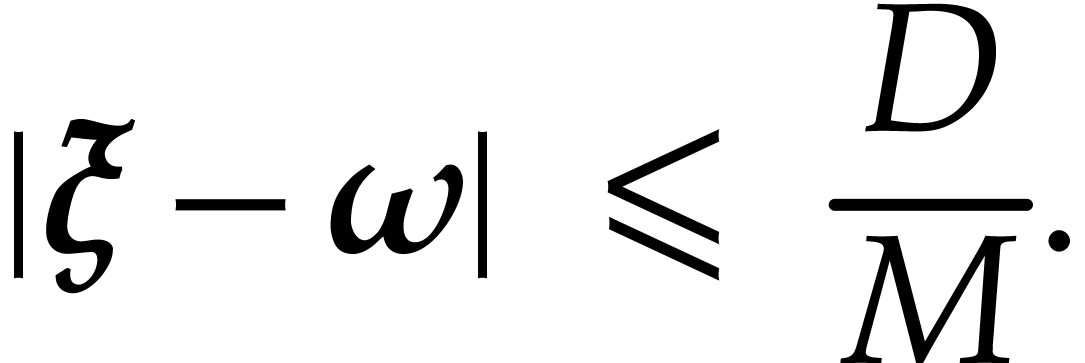 |
(21) |
and

Choosing sufficiently large, we will be able to
apply Algorithm 3 in order to evaluate 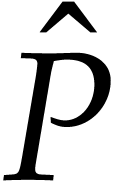 at the spiroid
  . We are now
ready to prove the main theorem of this paper, from which Theorem 1 follows.
. We are now
ready to prove the main theorem of this paper, from which Theorem 1 follows.
Proof. Using binary powering, the computation of
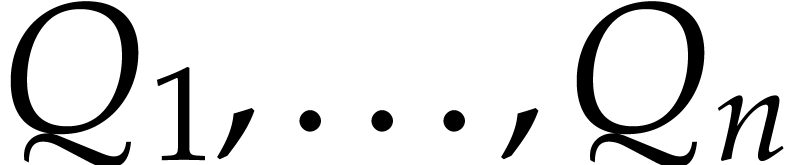 takes time

Now we take

whence 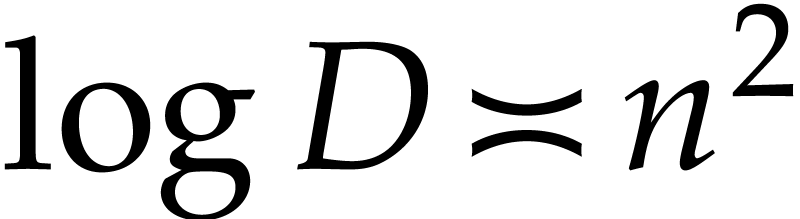 . More precisely, we
have
. More precisely, we
have

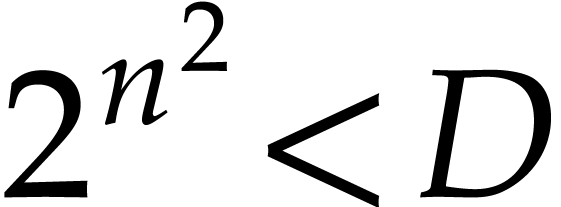 , and
, and  . We distinguish the following cases in order to
construct the sequence :
. We distinguish the following cases in order to
construct the sequence :
If 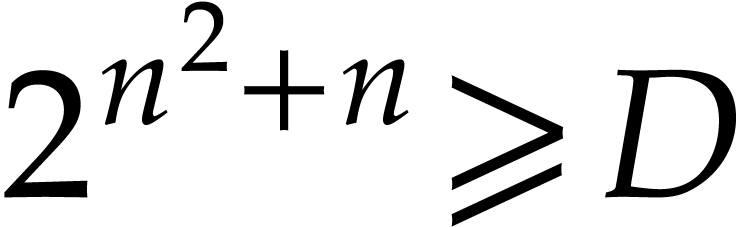 then we take
minimal such that
then we take
minimal such that 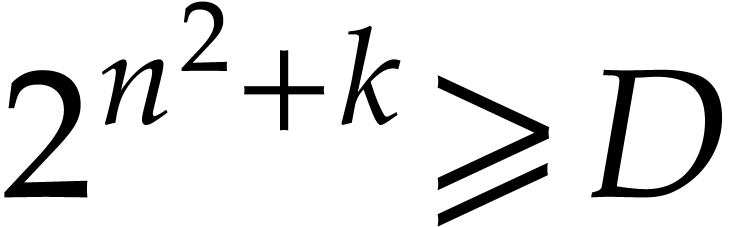 , and
then
, and
then  and
and  .
Note that
.
Note that 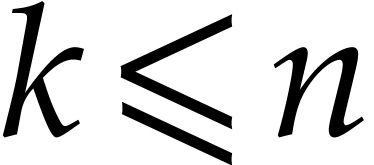 does exist.
Otherwise, 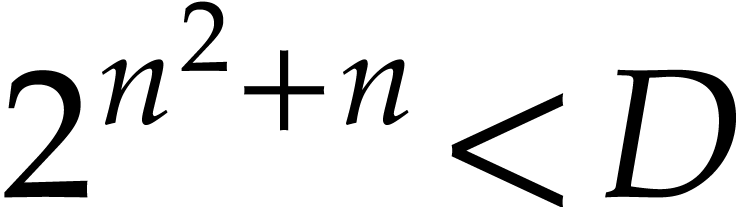 .
.
If 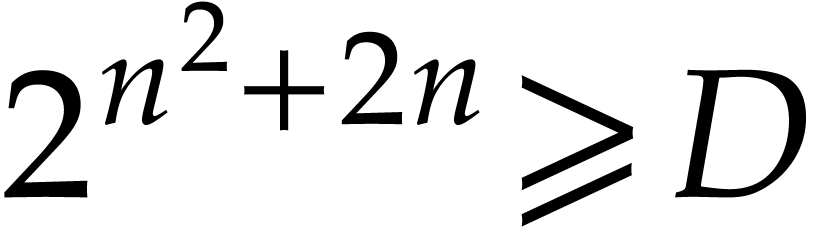 then we take
minimal such that
then we take
minimal such that 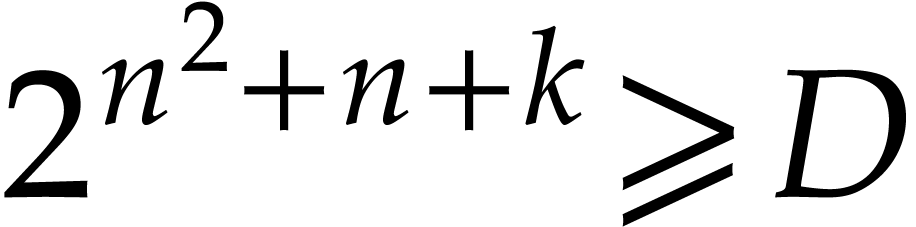 ,
and then
,
and then  and
and  .
.
Otherwise we take 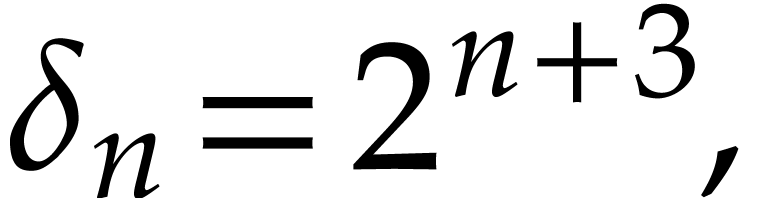
 .
.
In this way we achieve 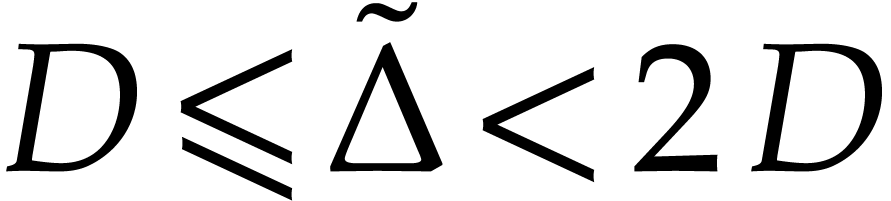 and
and
 |
(22) |
whence
 |
(23) |
and
 |
(24) |
Recall that 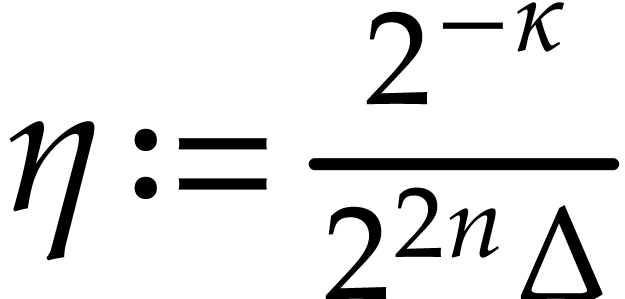 . Now we take
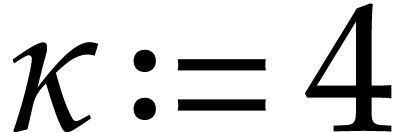 and
and 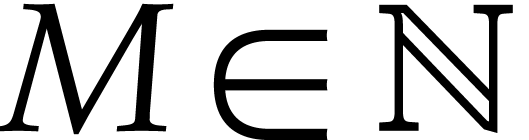 minimal such that
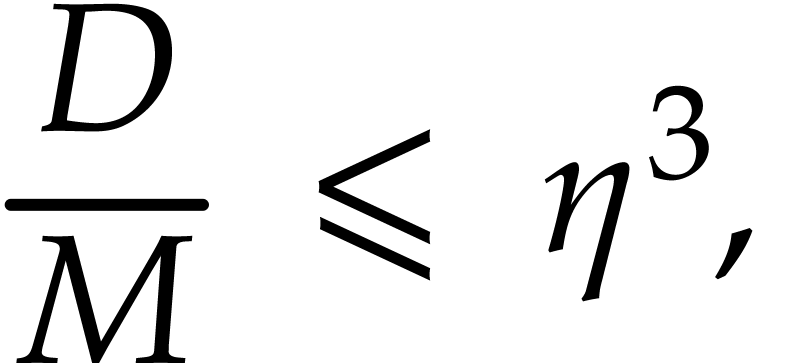
so, using
 |
(25) |
With this choice for 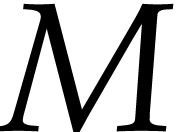 , the
inequality
, the
inequality
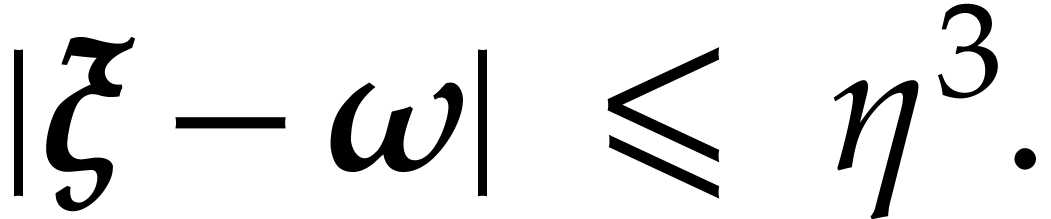
Let 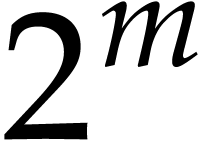 be the smallest power of two that satisfies
 , so we have
 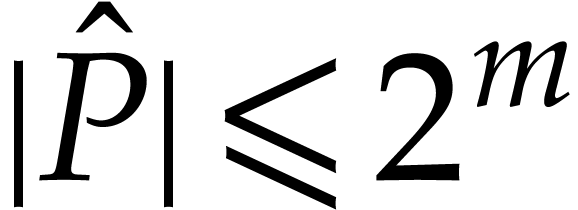 . We set

From
and that
 |
(27) |
Since  , using Lemma 5
with
, using Lemma 5
with  , we compute a
truncation
, we compute a
truncation 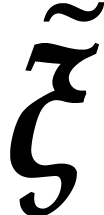 of
of 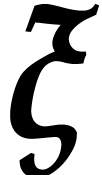 with error
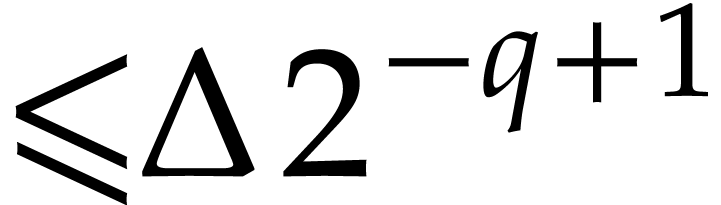 in time
Since , Proposition 23
allows us to compute an evaluation tree for with
error in time
Following Proposition 19, this bound dominates the cost for
obtaining an approximation  of
of 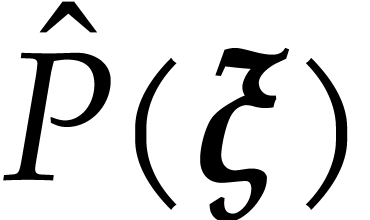 with error
 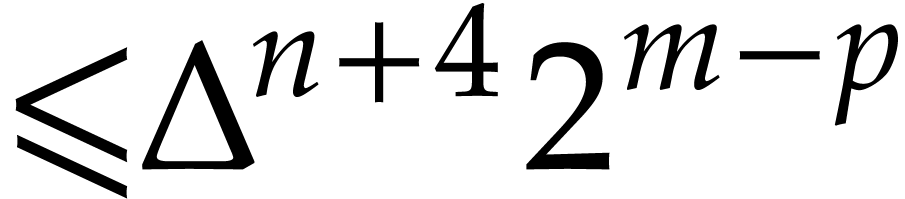 , where
  , so we have

hence
 |
(30) |
thanks to Lemma 10. Via Lemma 5, we compute
 such that
 |
(31) |
in time  , using
so rounding the coefficients of 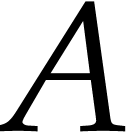 to the nearest
integers yields
to the nearest
integers yields 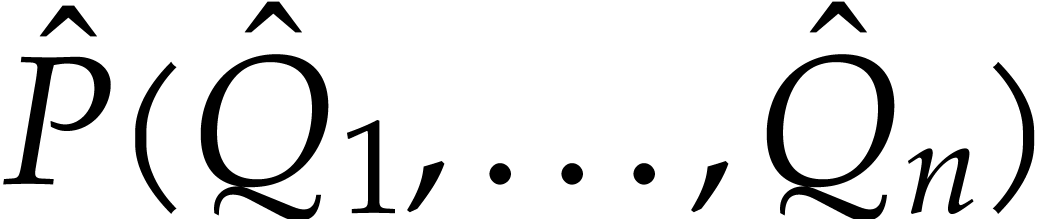 . Since
we compute  in time
 |
|
 |
|
|
 |
||
|
 |
(using |
The final division of by
over 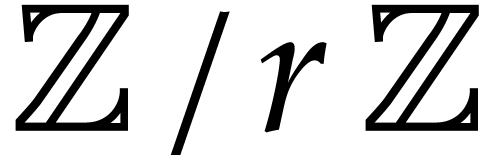 has cost
The total cost of the method is dominated by
V. Bhargava, S. Ghosh, Z. Guo, M. Kumar, and C. Umans. Fast multivariate multipoint evaluation over all finite fields. In 2022 IEEE 63rd Annual Symposium on Foundations of Computer Science (FOCS), pages 221–232. New York, NY, USA, 2022. IEEE.
V. Bhargava, S. Ghosh, M. Kumar, and C. K. Mohapatra. Fast, algebraic multivariate multipoint evaluation in small characteristic and applications. J. ACM, 70(6):1–46, 2023. Article No. 42.
R. P. Brent and H. T. Kung. Fast algorithms for manipulating formal power series. J. ACM, 25(4):581–595, 1978.
P. Bürgisser, M. Clausen, and M. A. Shokrollahi. Algebraic Complexity Theory, volume 315 of Grundlehren der Mathematischen Wissenschaften. Springer-Verlag, 1997.
J. von zur Gathen and J. Gerhard. Modern computer algebra. Cambridge University Press, New York, 3rd edition, 2013.
D. Harvey and J. van der Hoeven. Integer
multiplication in time  .
Ann. Math., 193(2):563–617, 2021.
.
Ann. Math., 193(2):563–617, 2021.
D. Harvey, J. van der Hoeven, and G. Lecerf. Even faster integer multiplication. J. Complexity, 36:1–30, 2016.
J. van der Hoeven. The Jolly Writer. Your Guide to GNU TeXmacs. Scypress, 2020.
J. van der Hoeven and G. Lecerf. Composition modulo powers of polynomials. In Proceedings of the 2017 ACM on International Symposium on Symbolic and Algebraic Computation, ISSAC '17, pages 445–452. New York, NY, USA, 2017. ACM.
J. van der Hoeven and G. Lecerf. Modular composition via factorization. J. Complexity, 48:36–68, 2018.
J. van der Hoeven and G. Lecerf. Fast multivariate multi-point evaluation revisited. J. Complexity, 56:101405, 2020.
J. van der Hoeven and G. Lecerf. Univariate polynomial factorization over finite fields with large extension degree. Appl. Algebra Eng. Commun. Comput., 35:121–149, 2024.
E. Kaltofen and V. Shoup. Fast polynomial factorization over high algebraic extensions of finite fields. In Proceedings of the 1997 International Symposium on Symbolic and Algebraic Computation, ISSAC '97, pages 184–188. New York, NY, USA, 1997. ACM.
K. S. Kedlaya and C. Umans. Fast polynomial factorization and modular composition. SIAM J. Comput., 40(6):1767–1802, 2011.
Y. Kinoshita and B. Li. Power series composition in near-linear time. In 2024 IEEE 65th Annual Symposium on Foundations of Computer Science (FOCS), pages 2180–2185. IEEE, 2024.
V. Neiger, B. Salvy, É. Schost, and G. Villard. Faster modular composition. J. ACM, 71(2):1–79, 2023. Article No. 11.
M. S. Paterson and L. J. Stockmeyer. On the number of nonscalar multiplications necessary to evaluate polynomials. SIAM J. Comput., 2(1):60–66, 1973.
A. Schönhage. Asymptotically fast algorithms for the numerical muitiplication and division of polynomials with complex coefficients. In J. Calmet, editor, Computer Algebra. EUROCAM '82, European Computer Algebra Conference, Marseilles, France, April 5-7, 1982, volume 144 of Lect. Notes Comput. Sci., pages 3–15. Berlin, Heidelberg, 1982. Springer-Verlag.
V. V. Williams, Y. Xu, Z. Xu, and R. Zhou. New bounds for matrix multiplication: from alpha to omega. In D. P. Woodruff, editor, Proceedings of the 2024 Annual ACM-SIAM Symposium on Discrete Algorithms (SODA), pages 3792–3835. Philadelphia, PA 19104 USA, 2024. SIAM.
 modular
composition over
modular
composition over 
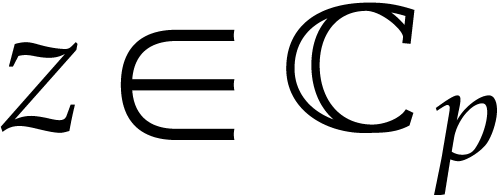 and
and 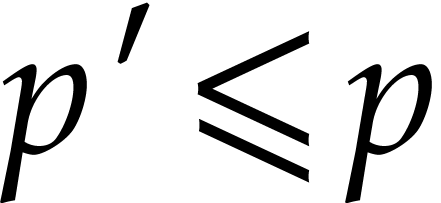 ,
, in
in 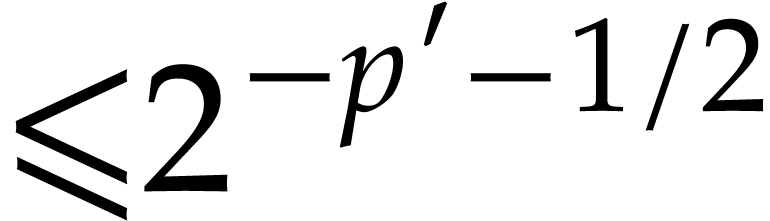 in time
 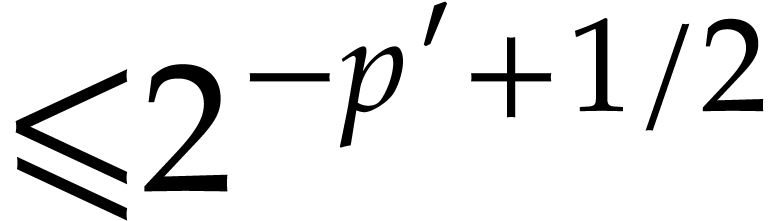 in time
 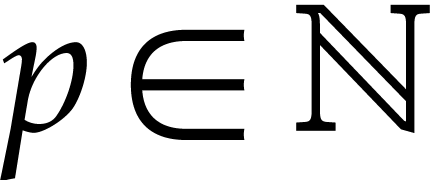 ,
, in
in  .
. ,
, with error
  .
. .
.
 .
. of
of  .
. .
. and let
  non-zero terms. Then we have

 ,
, for all
  .
.
 .
.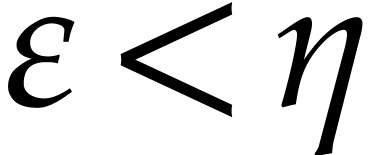 .
.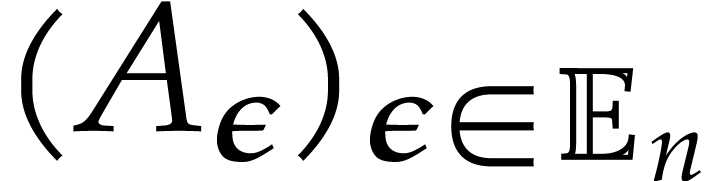 of
of 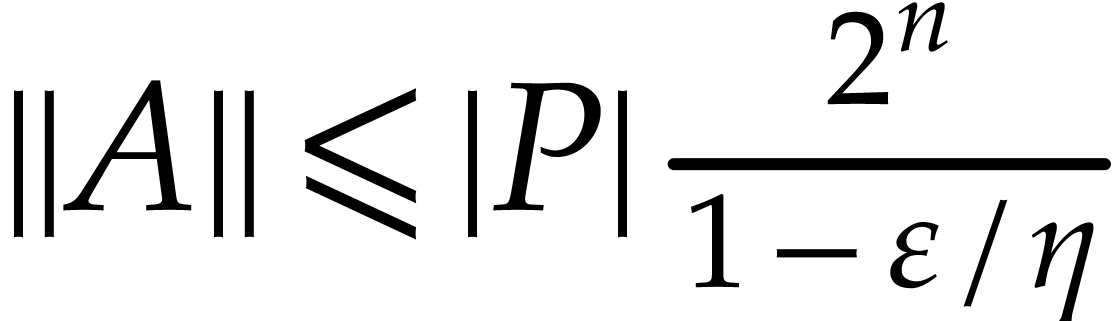 .
.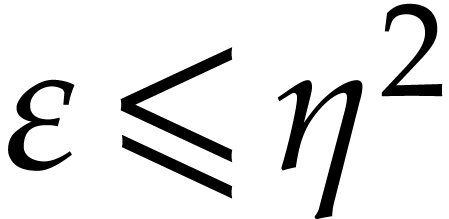 .
.






 ,
, ,
,




 of
of  with error
  and evaluation trees for
 in
in  ,
,
 .
. and
and  in time











 such that
  .
.





 of
of
 where
where
 .
. .
.














 )
)